A2A: the quiet protocol that lets anything talk to anything
How A2A connects agents, how it differs from MCP, and how an automotive profile carries an inventory search through to a shopper-approved dealership inquiry.

Alex YankouskiAuthor
A shopper’s assistant needs a way to ask a dealership what is in stock and return information it can use. A2A supplies a common way for agents to discover each other and exchange work. The dealership still needs to define its vehicle data, supported operations and permission rules.
What A2A actually is
A2A stands for Agent-to-Agent. It is an open protocol for communication between agents built by different teams. An agent publishes an agent card describing its capabilities and endpoint. Another agent can use that information to request work and receive a response.
Google introduced A2A in April 2025 and later contributed it to the Linux Foundation. Its open specification gives implementations a shared contract.
MCP addresses a related connection: access to tools and data. A2A describes communication between agents. A product can use both, depending on the systems it connects.
Who can participate
An agent endpoint can represent a service backed by an AI model, an existing API or a workflow involving people. The receiving system decides how to perform the requested work.
For a dealership, inventory search can run against its current feed. An appointment request can go to a person for confirmation. Publishing an endpoint does not mean every operation needs a language model or can run without approval.
Tasks across systems
Shared message and task conventions let agents coordinate work without inventing a new envelope for every connection. Longer tasks can report progress while the caller waits for a result.
The application still has work to do: authenticate callers where required, validate requests, enforce permissions and handle failures. The protocol provides communication conventions; it does not make every participant trustworthy or every requested operation available.
Where to start building
Start with the A2A documentation and official project repository. Choose the version supported by the systems you need to connect, then test discovery, a successful request and the failure path.
A small inventory lookup is a useful first integration: its inputs and returned vehicle facts can be checked against the source feed before adding any operation that contacts a customer.
Why the vehicle vocabulary matters
A message format alone cannot tell an assistant whether a price includes mandatory dealer charges, whether a vehicle is still available, or which dealership should receive an inquiry. Those meanings need an industry-level contract.
Auto Agent Protocol defines automotive operations and vehicle data for participating systems. Implementations must agree on the supported profile and validate the information they exchange.
An automotive example
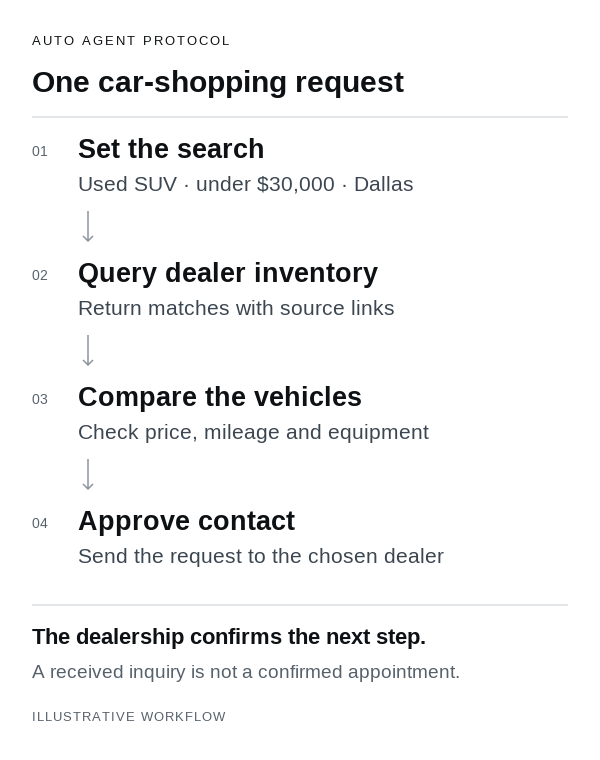
Suppose a shopper asks for a used SUV under $30,000 near Dallas. The assistant sends supported search criteria to the inventory connection and receives matching vehicles with identifiers, prices and source links. It requests details for two selected vehicles and presents a comparison.
If the shopper wants a visit, the assistant asks for their contact details and permission to send the request to the selected dealership. A successful submission acknowledges receipt; it does not mean the dealership has confirmed the appointment.
Dealer Handshake operates this kind of managed inventory connection and CRM delivery. Auto Agent Protocol remains an independently published open standard.
What to test before launch
Check a current vehicle, a changed price and a removed listing against the feed. Confirm that a request stays attached to the selected vehicle and dealership, and that a failed lookup is shown as a failure.
Test inquiry delivery separately, with explicit contact consent and a known receiving CRM. Keep the source records and results so the same checks can be repeated after updates. Our ten-VIN inventory test provides a practical starting set.