Your cars are in Canada. Can AI find them?
The next shortlist can start with a question to an AI assistant. Canadian dealers need their actual vehicles in the answer. Dealer Handshake already supports Canada alongside the U.S.
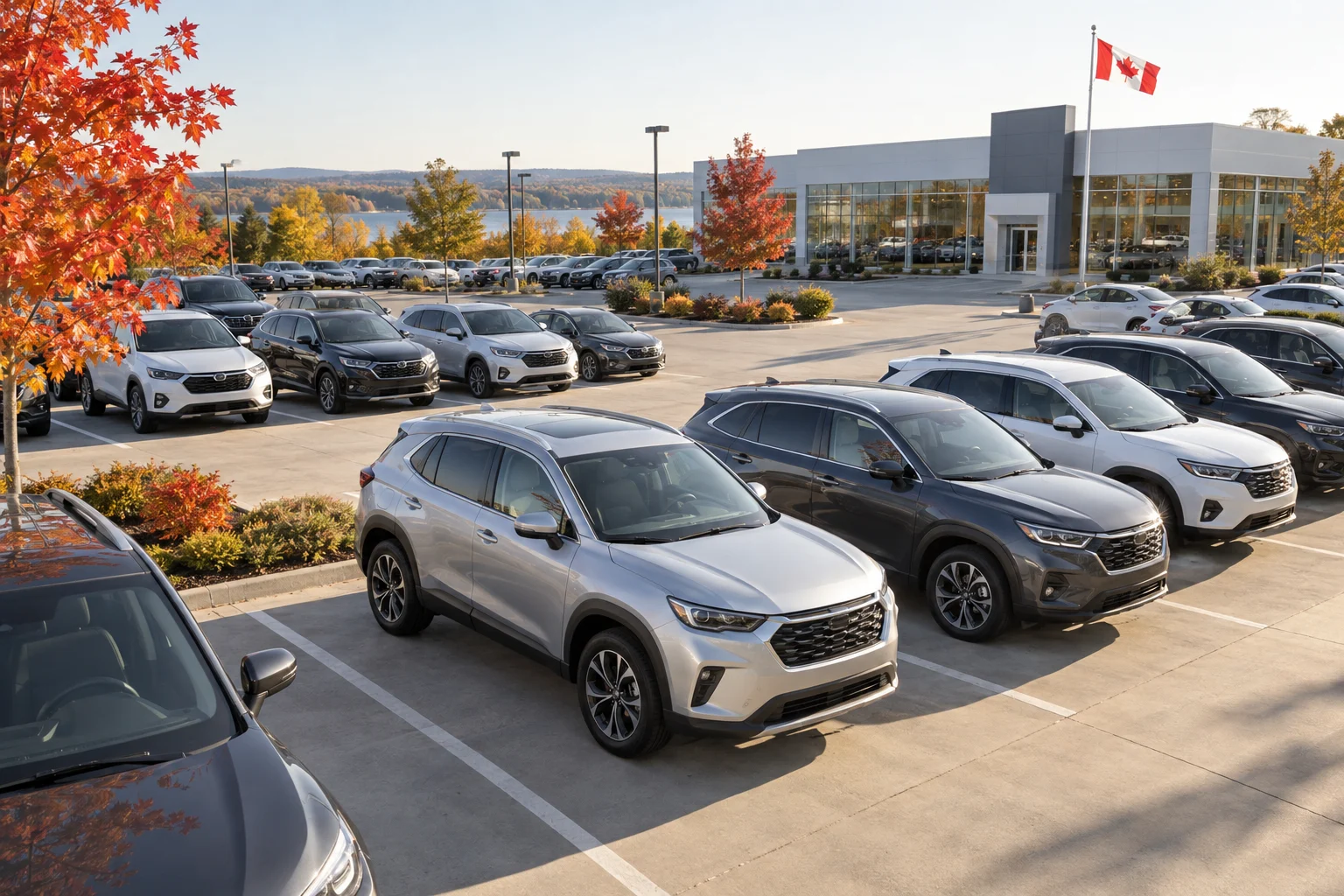
Imagine a buyer in Ottawa asking an AI assistant: “Find me a used AWD SUV under C$35,000, with fewer than 80,000 km, heated seats and a dealer within 50 km.”
Your dealership has the right vehicle. The price is competitive. The photos are excellent. Your sales team could arrange a test drive this afternoon.
But can the assistant find that particular car, understand its equipment and send the buyer to the right store?
That is the commercial test of AI discoverability for Canadian car dealers. A dealership can be easy to find by name while its stock remains difficult to search by what a buyer actually needs.
We built Dealer Handshake around that problem. Dealer Handshake already supports participating Canadian dealerships outside Quebec, alongside dealerships in the United States. Canadian dollars, kilometres and Canadian locations are part of the supported shopping experience. For a Canadian store, the conversation can start with connecting its inventory today.
AI search is already a Canadian channel
Canada is a substantial automotive market in its own right. Statistics Canada reported 1,958,582 new motor vehicles sold in 2025, up 2.1% from 2024. The total covers new motor vehicles, including trucks and buses. Source: Statistics Canada, March 16, 2026.
The search environment around those purchases is changing. Google began rolling out AI Mode in Canada in English on August 21, 2025, bringing conversational questions, comparisons and follow-ups directly into Search. Across its early users, Google observed questions two or three times as long as traditional search queries. Source: Google’s Canadian launch announcement.
For a dealer, a longer question can contain more reasons for a particular vehicle to qualify: budget, kilometres, equipment and location. Each useful detail in your inventory gives the assistant more evidence to match against the request.
There is also measurable familiarity with the tools. In March 2026, 35.9% of Canadian workers aged 15 to 69 reported using generative AI for their main job or business during the previous 12 months. This measures workplace use; it does not tell us how many Canadians shop for cars with AI. Source: Statistics Canada, July 30, 2026.
The practical implication for dealers is clear: Canadian buyers have access to conversational search, and many already have experience asking AI tools for help. The question for a dealership is whether its inventory is ready to answer.
The shortlist depends on three different jobs
Consider what has to happen between that Ottawa question and an inquiry in your CRM.
1. Find the dealership
The assistant needs reliable information about your business: its name, location, website and the markets it serves. Readable pages, accurate business listings and useful local content give search systems evidence to work with.
2. Find a matching vehicle
Now the question becomes specific. Which vehicle is within budget? Does the supplied record establish AWD and heated seats? Which rooftop has it? Is the listing still active? A general description of your dealership cannot answer those questions for every VIN on the lot.
3. Make the next step work
When the buyer chooses a vehicle and agrees to make contact, the inquiry needs to reach the correct dealership with the vehicle attached. Otherwise, the store starts by reconstructing a conversation the buyer has already had.
Each job deserves its own measurement: a store mention, an accurately retrieved vehicle and a successfully delivered inquiry. Counting them separately makes the value of an AI project much easier to assess.
Google is unusually direct about the first job. Its documentation says the established SEO fundamentals still apply to AI Overviews and AI Mode. A supporting page must be indexed and eligible to appear with a snippet. There is no special AI schema or new AI text file required, and meeting the requirements does not guarantee inclusion. Source: Google Search Central.
Keep doing that work. Then test whether a supported inventory connection can answer the vehicle question too. Search visibility and a direct connection are separate ways for a buyer to reach your stock.
In Canada, the details change the answer
A Canadian shopping experience needs to preserve the meaning of the inventory. Four details make a useful acceptance test.
A dollar amount needs a currency
C$35,000 is a Canadian-dollar budget. The currency belongs with the listing and with the search constraint. A bare dollar sign gives an assistant less information than an explicit CAD value, especially when a service covers both sides of the border.
An odometer needs a unit
A vehicle with 80,000 kilometres and one with 80,000 miles have very different histories of use. The number and unit need to travel together from the source feed to the answer. The same applies to the shopper’s search radius.
“Near me” needs the right country and rooftop
A buyer in Windsor, Ontario needs location handling that understands the Canadian market. A dealer group also needs each vehicle attached to the store that actually has it. A plausible city name or the group’s head-office address is insufficient for planning a visit.
A price needs its conditions
Ontario provides a concrete example. OMVIC says an advertised vehicle price must include the fees and charges the dealer intends to collect, with HST and licensing as permitted exceptions. If those are excluded, the advertisement must clearly say so. Source: OMVIC’s all-in price advertising guidance.
That is Ontario guidance, not a Canada-wide pricing rule. The operational lesson travels: an assistant should preserve the source price and its stated conditions, and send the buyer back to the dealer for anything the record does not establish. A finance-only offer should not quietly become an unconditional cash price.
Equipment deserves the same care. If a buyer requires heated seats, a useful answer needs evidence for that vehicle. Inferring them from a familiar model name can put the wrong car on the shortlist.
Dealer Handshake already supports Canada
This is where Dealer Handshake becomes useful to a Canadian dealer. We connect dealer-authorized inventory to supported AI shopping experiences through the Auto Agent Protocol, the open automotive standard our team created.
Car Handshake is the shopper-facing experience. Dealer Handshake is the connection behind the participating dealership: inventory in, searchable vehicle facts out, and a buyer-approved inquiry back to the configured lead workflow.
The Canadian market is already supported with CAD pricing, kilometre-based vehicle mileage and search distances, and Canadian location handling. Current coverage is participating dealers in supported Canadian markets outside Quebec. Available results depend on which stores are connected and the inventory they supply.
In a supported assistant connection, a shopper can search participating stock, inspect returned vehicle details and choose whether to contact the selling dealership. The ChatGPT inventory guide explains dealer participation, shopper setup and the handoff. The connection needs to be available and enabled for the shopper; general AI search answers are selected independently.
For your store, the value is concrete. A vehicle can be matched against a buyer’s request using the facts you supply. An interested buyer can carry that vehicle into an inquiry. Your team can verify the result against its own inventory and CRM.
Bring us a vehicle your team knows and a question it should match. That gives us something useful to demonstrate: the path from the buyer’s request to your actual stock.
Ask for proof with ten vehicles from your own lot
The strongest demo starts with inventory your team knows. Choose ten VINs, including a new arrival, a recent price change, a sold unit and a vehicle with a feature buyers frequently request. For a group, include more than one rooftop.
Our ten-VIN inventory test gives the full method. Add these Canadian checks:
| Check | Evidence your team should see |
|---|---|
| Canadian budget | The listing currency is CAD; the returned price agrees with the source. |
| Kilometres | Odometer values and search distances retain the correct units. |
| Location | The vehicle belongs to the correct Canadian rooftop and search area. |
| Equipment | A requested feature is supported by the listing, or the missing information is acknowledged. |
| Stock changes | A price update and a sold unit are handled within the agreed feed-update window. |
| Buyer handoff | With the tester’s consent, the inquiry arrives at the intended store with the selected vehicle. |
Save the request, returned vehicle identifiers and timestamps. Ten deliberately selected vehicles are a practical diagnostic sample, not a market-wide performance claim. Repeat a failed case after the underlying issue is fixed.
A useful trial ends with evidence your inventory manager and sales manager can both recognise.
Give the next buyer a car to find
Your dealership already does the hard work: sourcing vehicles, preparing them for sale, setting prices and helping people buy. Those facts deserve to survive the journey into an AI conversation.
For Canadian dealers, the opportunity starts with making the right car retrievable in the right market, at the right price, with a useful next step. Dealer Handshake already supports that connection in Canada outside Quebec, alongside the U.S.
Your next buyer can ask a very specific question. Give the assistant something specific to find.
Connect your Canadian dealership to review your feed and a test with your own inventory. To check what can be read from your website first, run the free visibility scan. The website scan and the connected inventory test measure different parts of the journey.
Sources and scope
Published October 16, 2026. External facts were checked against these primary sources. The Ottawa shopping request is an illustrative scenario; the ten-VIN exercise is a proposed test.
- Statistics Canada: New motor vehicle sales, January 2026, March 16, 2026. Includes the 2025 annual sales total; figures are subject to revision.
- Google: Introducing AI Mode in Canada, August 21, 2025. Canadian rollout and the separately scoped early-user query-length observation.
- Statistics Canada: Use of generative AI tools among Canadian workers, March 2026, July 30, 2026. Workplace adoption among workers aged 15 to 69.
- Google Search Central: AI features and your website. Search eligibility and technical guidance.
- OMVIC: All-in price advertising. Ontario dealer advertising guidance.
Product scope: Dealer Handshake’s connection guide and current shopper setup instructions. Canada support covers participating dealerships outside Quebec. Dealer Handshake publishes this article and provides the service described.