Personal Agent Protocol: the front door for AI agents — and where automotive fits
What the Personal Agent Protocol announcement means for dealerships, and how its identity and permission layer fits with the automotive vocabulary of AAP.

Alex YankouskiAuthor
Editorial update — October 11, 2026
The article below was first published on October 6, 2026, when PAP had just been announced. The public PAP v0.2 draft is now available, and Car Handshake’s PAP discovery document is live. References below to a forthcoming specification, open design questions and planned integration describe the position at the original publication date.
For the implementation and what it means for dealers now, read Your next car buyer may never visit your website.
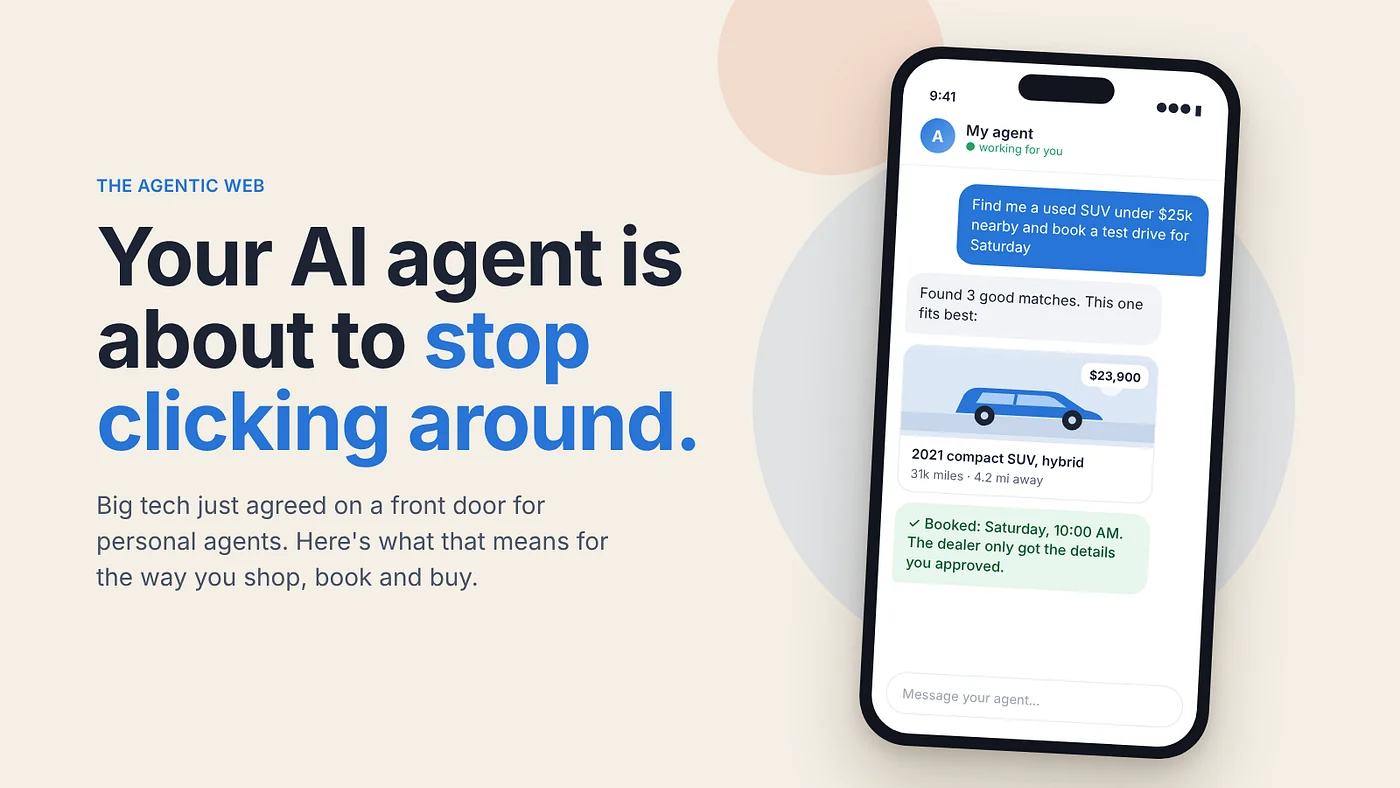
How do you expect an AI agent to find your business? Not a person typing into Google. An agent, acting for a person, with a task to finish.
Until today, most answers were custom one-offs. A special API here, an llms.txt there, a chatbot that only works if you already know it exists. None of it is a shared standard, so most agents fall back to the slowest option: loading web pages and clicking through forms like a very patient human.
On October 6, 2026, that changed. Meta and Sierra, together with Genesys, Instinct, Rocket, Shopify, Stripe and Walmart, announced the Personal Agent Protocol (PAP): an open standard for how personal agents interact with businesses.
I co-created the Auto Agent Protocol (AAP), an open standard for agents talking to car dealerships. So I read the announcement with one question in mind: what does PAP actually give us, and how does a vertical standard like AAP connect to it? This post is my answer.
What PAP is
PAP is an open standard that defines how a personal agent — an AI acting for one person — connects to a company. It covers three things: authentication, consumer control, and giving companies visibility into what agents do on their website, APIs or company agent.
The announcement was written by Sierra co-founders Bret Taylor and Clay Bavor. Meta’s involvement is not incidental: it comes a month after Meta launched Muse, its personal agent. Muse needs a sanctioned way into businesses, and so does every other personal agent.
Two facts are worth stating clearly, because headlines blur them:
- It is announced, not shipped. The v0.1 specification, a reference implementation and design workshops are planned for later in October 2026. As of writing, there is no public spec or repository.
- It is open. Anyone can implement it. Bret Taylor has said OpenAI and Anthropic are not participating yet, and that broad participation is what makes it a real standard.
The problem it solves
Today a personal agent has two bad options. It can drive a website like a person, slowly and fragile to every redesign. Or it can call a support line or open a web chat, which takes even longer and often fails. A direct, agreed connection could do the same task securely in seconds.
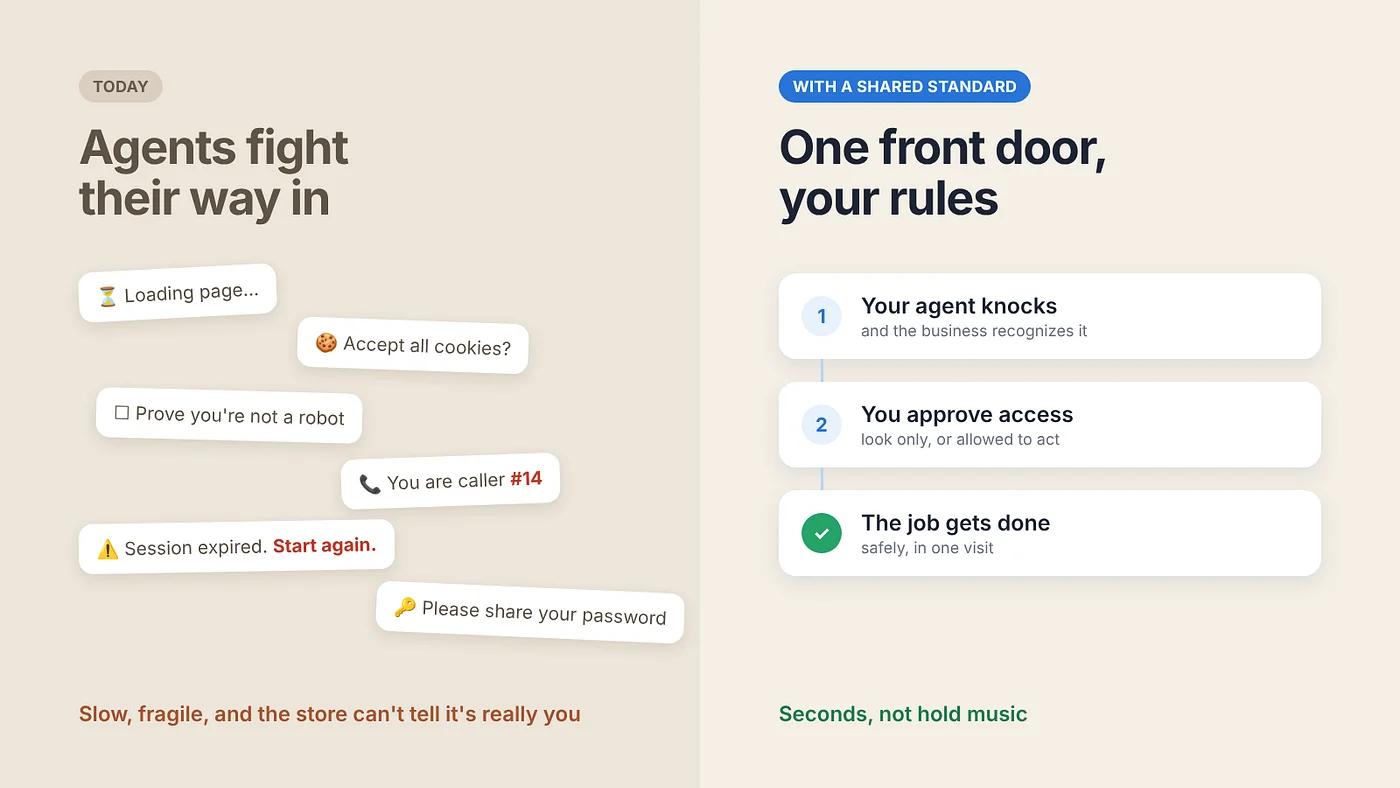
The catch is that three parties need different things from that connection:
- Consumers want speed, reliability, and an agent they trust to act in their interest.
- Businesses want to know when an agent is acting for a customer, and to decide what it may do.
- Agent builders want one consistent way to work with every participating company.
Without a standard, each business invents its own answer, each agent builder integrates them one by one, and most businesses end up blocking agents because they cannot tell a customer’s agent from a scraper. PAP’s pitch is that one shared front door works for all three.
How PAP works
The core rule is simple: the customer decides what access their agent gets, and the business decides what agents can do. Everything else follows from that.
- Discovery. It starts on the company’s website, where the agent learns what the company offers and how to reach it.
- Guest session. The agent opens a session for its user, first as a guest. That is enough for public questions like stock availability or a returns policy.
- Sign-in. When a task needs the customer’s account, the customer signs in on the company’s own page or uses credentials already set up with their agent. Bret Taylor compared it to “Sign in with Google”.
- Scoped access. The customer chooses read-only or write access. The agent never gets more than that.
- One session across channels. The session is built on OAuth and follows the customer across channels. A question asked as a guest and an order change made after sign-in are one visit, not two strangers.
- Execution route. The business chooses how the work gets done: through its website, through APIs built on standards like MCP and OpenAPI, or through its own company agent for conversational tasks such as a warranty claim.
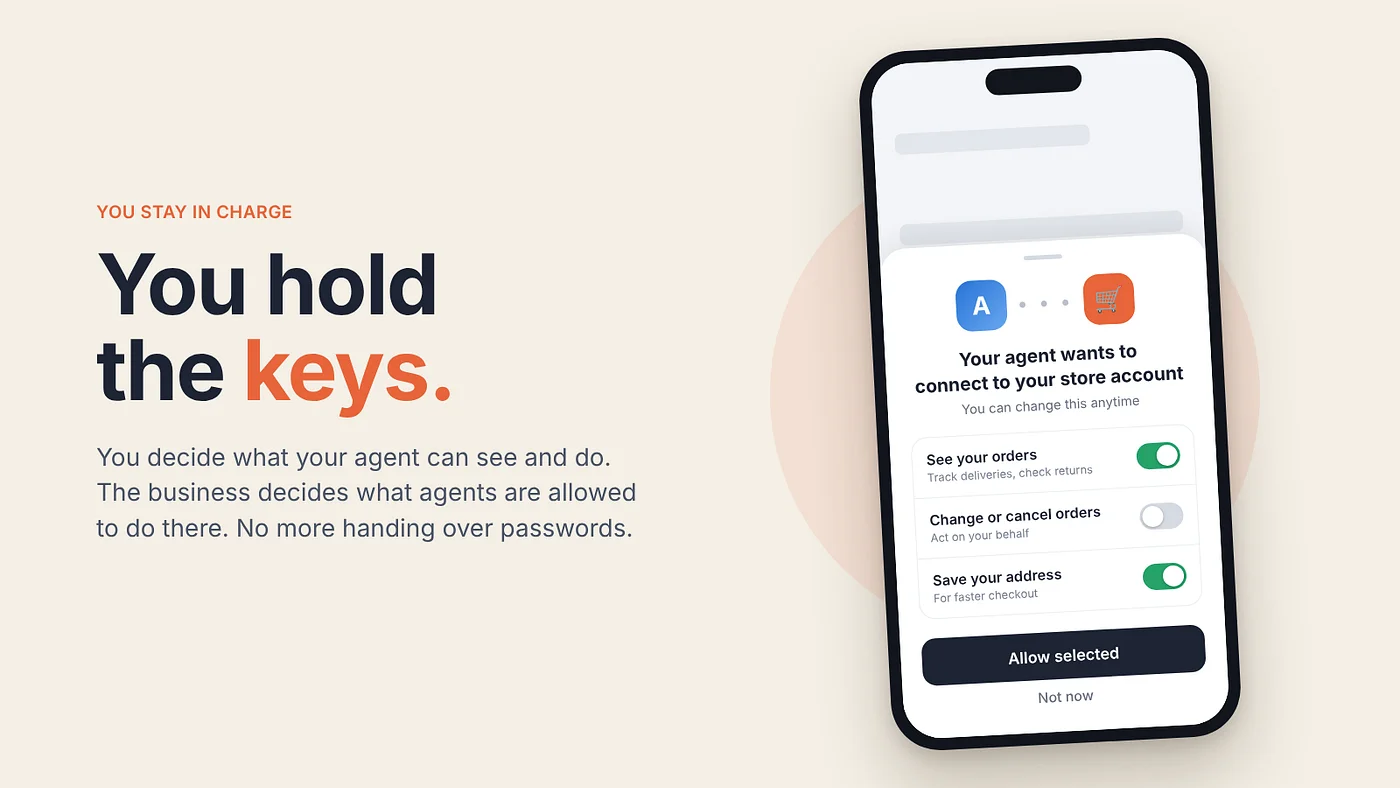
Step 5 is the quiet breakthrough. Today, a chat, an API call and a web visit from the same person look like three unrelated events. PAP makes them one customer journey that the business can see and govern.
The roadmap goes further. Finer-grained permissions could limit specific actions. Push notifications could let a company tell an agent the moment a flight is delayed or an order ships. Payment extensions could let an agent complete a purchase without ever seeing a card number. According to The Next Web, payments are a future extension, not part of v0.1.
Why the names behind it matter
Protocols don’t win on technical merit alone. They win when both sides of the market show up. Look at who is in this group:
- Agent side: Meta, with Muse and billions of users across its apps.
- Commerce side: Walmart and Shopify, which together touch a huge share of online retail.
- Payments: Stripe, which already powers agent checkout for Muse through Link.
- Customer experience: Sierra and Genesys, which run the company agents and contact centres on the other end.
- Vertical proof: Rocket, which is already using agent technology across home search and mortgages.
That is the agent, the store, the checkout and the service desk in one room. Genesys CEO Tony Bates put the business case plainly: brands need a trusted way to know who an agent represents, what it is authorised to do, and how to work with it securely.
For anyone building in agentic commerce, this is the signal we’ve been waiting for. The question is no longer whether agents will transact with businesses. It’s which standards they will use when they do.
What PAP doesn’t answer yet
PAP is deliberately horizontal. It tells an agent how to get in and what it is allowed to do. It does not tell the agent what a product is, what a booking looks like, or how a lead is handed to a sales team. Those depend on the industry.
There are also real open questions to watch in the v0.1 spec:
- Discovery format. “Starts on the website” could mean a well-known file, an agent card, HTML metadata or something new.
- Agent identity. How does a business verify which agent it is talking to, not just which customer?
- Liability. PAP creates an audit trail of identity and consent. It does not decide who pays when an agent makes a costly mistake.
- Participation. OpenAI and Anthropic build major personal agents too. A standard without them is still a strong start, but not yet universal.
None of this is a criticism. It is what a v0.1 is for, and it is exactly why the design workshops matter.
Where Auto Agent Protocol fits
This is where vertical standards come in, and where I think PAP and AAP fit together rather than compete.
AAP is an open, automotive-specific profile of the open A2A (Agent2Agent) protocol. It defines how an agent discovers a dealership, reads its live inventory — including EVs and motorcycles — and connects the buyer to the dealer with explicit consent: a test drive, a trade-in appraisal, a vehicle inquiry.
PAP answers “who is this agent and what may it do?” for any business. AAP answers “which car, at which dealer, and what happens next?” for car retail. One is the front door; the other is the language spoken once you are inside.
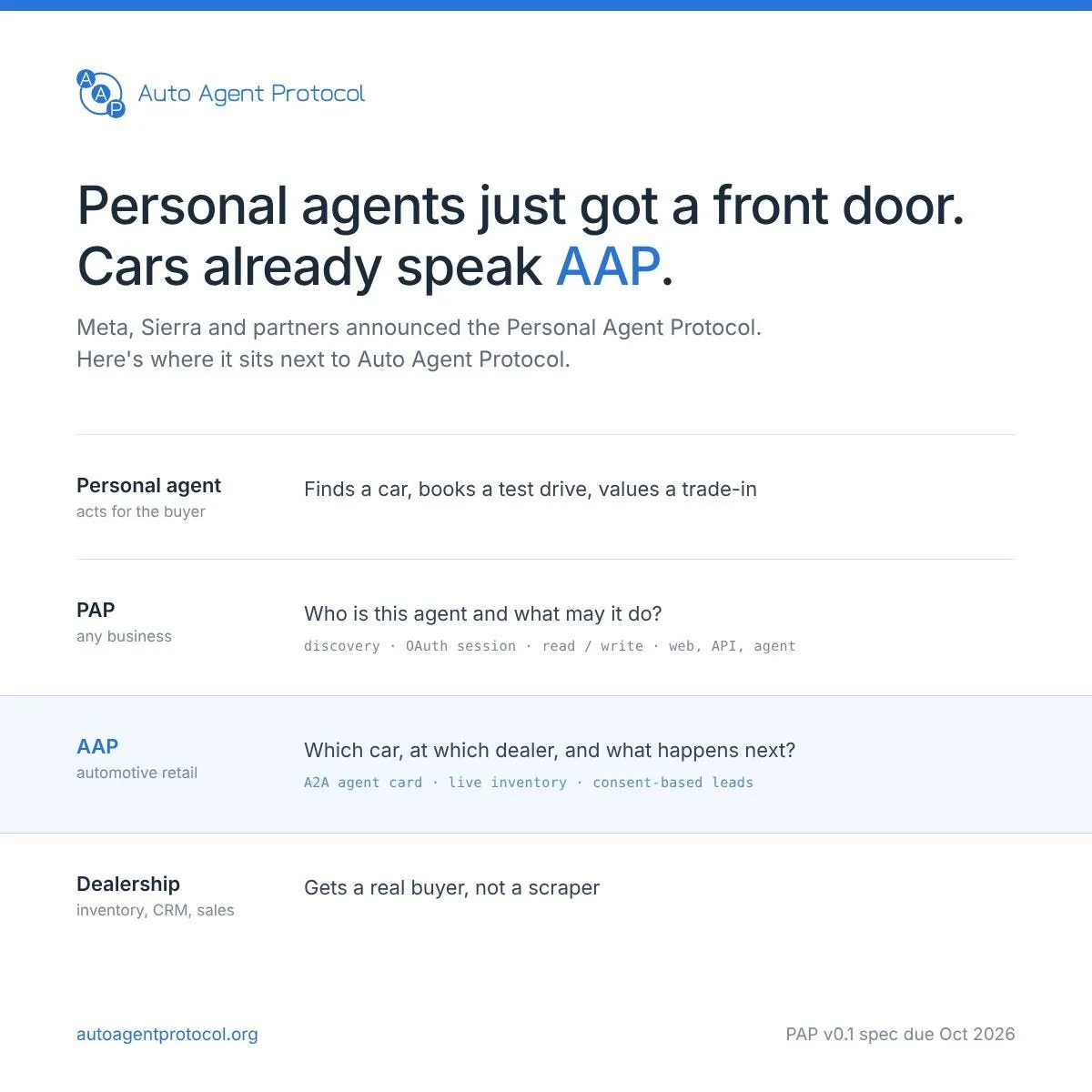
Read it top to bottom: the buyer’s agent passes through PAP’s identity and permission layer, then speaks AAP to a specific dealership.
Side by side:
- Scope: PAP covers any business. AAP covers car dealerships.
- Question it answers: PAP — who is the agent, and what is it allowed to do? AAP — which car, and what happens next?
- Built on: PAP uses OAuth, MCP and OpenAPI. AAP is built on A2A.
- Data model: PAP is generic by design. AAP defines vehicles, dealers and leads.
- Status: PAP is announced, with v0.1 due in October 2026. AAP is published, at v1.3.0.
Why does this layering matter? A dealer adopting AAP today can reuse its vehicle and lead vocabulary while adding PAP’s identity and session integration. PAP’s session and consent model can sit in front, and AAP keeps doing the automotive work behind it. Personal agents get one familiar way in; dealers keep a vocabulary built for how cars are actually sold.
What to do now
If you run a dealership or any customer-facing business, you don’t need to wait for v0.1 to get ready:
- Make yourself machine-readable. Clean, structured data about what you sell is the input to every protocol. If an agent can’t read your inventory, no sign-in flow will help.
- Decide your rules before agents arrive. What may an agent do as a guest? What needs the customer’s sign-in? What always needs a human?
- Pick the route. Website, API or your own agent. PAP lets you choose, so choose deliberately.
- Follow the spec. v0.1 is due later this month. Read it when it lands, and join the workshops if your industry needs a voice.
I’ll be reviewing the v0.1 spec closely, with one goal: making sure the automotive layer plugs into it cleanly.
And for dealers who don’t want to wait: Dealer Handshake onboards dealerships onto AAP today — from inventory feed to an agent-ready website to leads delivered straight into the dealer’s CRM.
The agentic web is getting its rails. The front door is being standardised by some of the biggest companies on earth. The question for every industry now is simple: once an agent is inside, does it speak your language?
Learn more about Auto Agent Protocol at autoagentprotocol.org. Read the original PAP announcement on the Sierra blog.