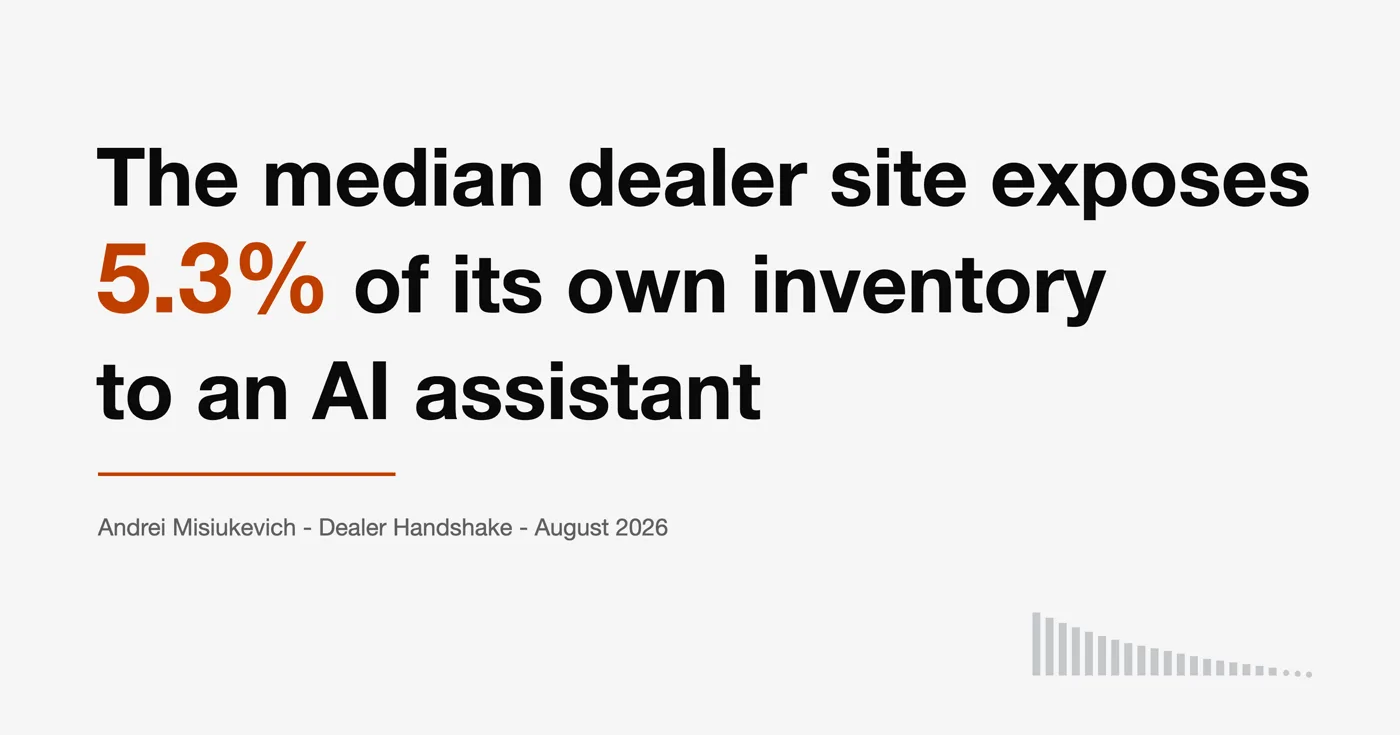
We measured what an AI assistant actually sees on a dealer’s website. The median was 5.3% of the lot.
It isn’t zero, which is the part that should worry you. Agents can read your store. They’re reading about one car in twenty.

Andrei MisiukevichAuthor
We ran this twice. Once at the end of July, quickly, on a sample we put together by searching. Then again in August, properly: we wrote the sampling rule down before collecting a single domain, froze the list, scanned every site on it, and removed nothing afterwards. The August run is where the numbers below come from. The July run matters because it got the same answer, which is the only reason to trust either.
The first question was whether a machine can reach a dealer’s site at all.
We probed 234 US dealership domains from our own production network in Virginia, with a bot that honestly identified itself and its purpose. 138 answered. Eighty-five returned 403 Forbidden. Three rate-limited us after three polite, one-second-spaced requests, one went silent entirely, and seven redirected somewhere we did not follow.
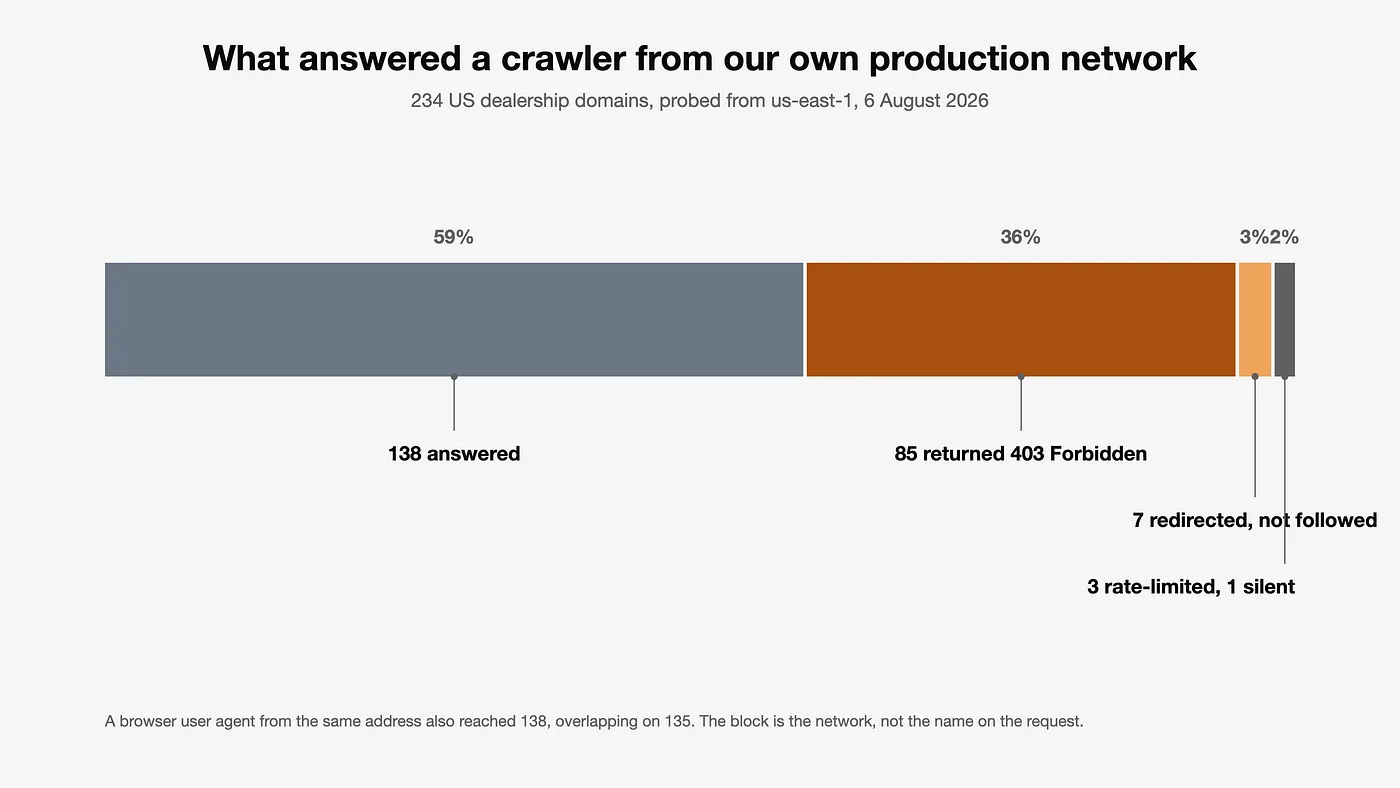
Two in five dealer domains will not talk to software arriving from a datacenter. And the block has nothing to do with who you say you are: a normal browser user agent from the same address reached just as many. Three domains let the browser through and refused the honest bot; three did the reverse. It is the IP and the network that get you refused, not the name on the request.
Which means that for two in five of these stores, the question of what an assistant can read never comes up. It cannot get to the door.
What the machine gets when it does get through
The second measurement asked what is actually readable once you are in.
We expected zero. The premise we started with was the one you hear everywhere: inventory pages are assembled in the browser, so software receives an empty shell.
It is not true, and our own first run said so within a day of us writing the premise down.
On the sites we could read, the vehicles were sitting right there in the server HTML, a median of twenty of them. Which makes complete sense the moment you think about who built those pages. Dealer website platforms sell search rankings as their primary value to the dealer, so of course they render inventory server-side.
The real problem is not visibility. It is proportion.
Of the 234 sites, 57 published both numbers in a form a machine could read: how many vehicles were actually exposed, and how many the store itself claimed to have in stock.
The median store exposed 5.3% of its own inventory. Forty-five of the fifty-seven were under 10%. One store advertising 451 vehicles exposed 24 of them. Five stores exposed nothing at all.
Two numbers in this sample would flatter the story if you let them, so here they are with the caveat attached. The best result is 58%, and it belongs to a small independent lot with 86 cars, where one page is most of the inventory. Among the forty stores claiming more than 300 vehicles, the best was 16.7% and the median 3.9%. The bigger the store, the worse this gets.
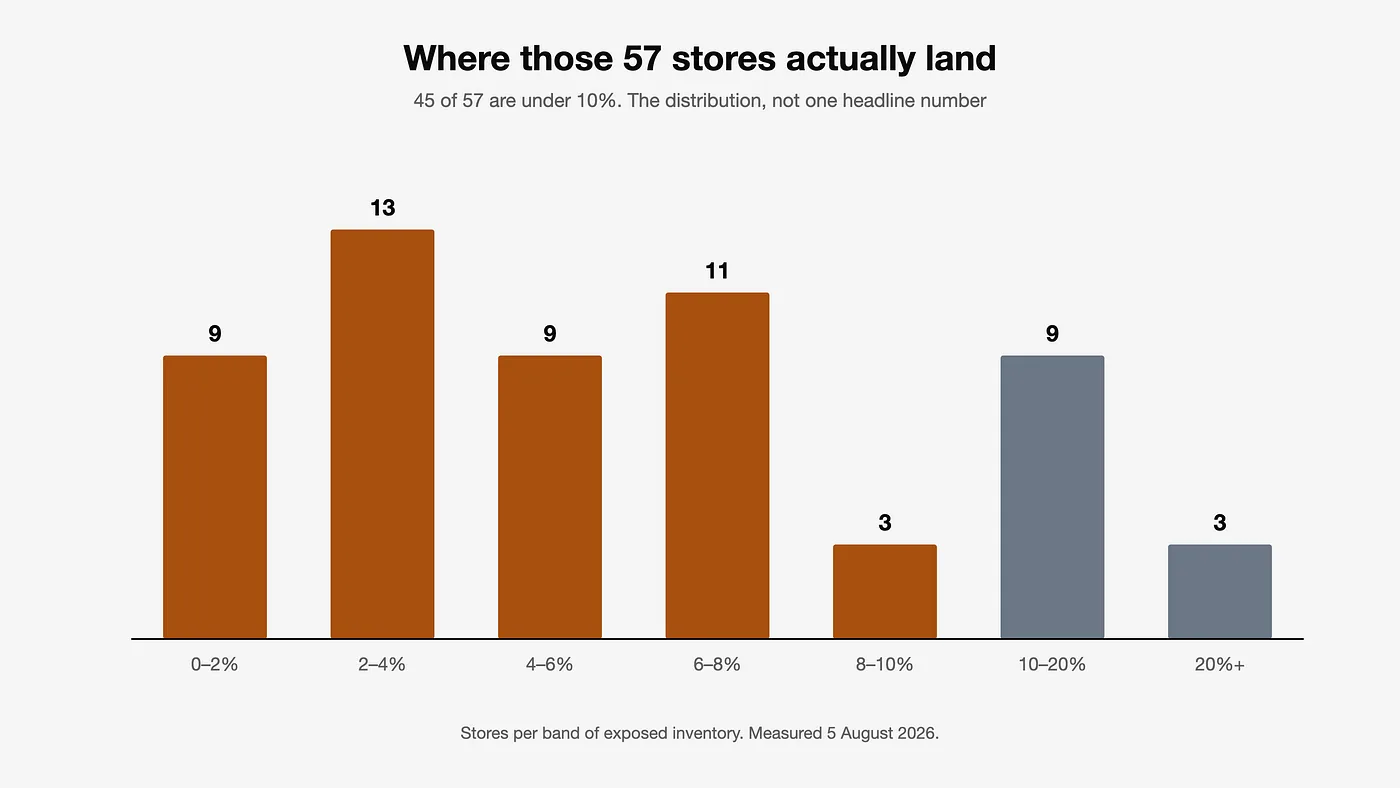
And the fifty-seven together claimed 62,176 vehicles while exposing 1,321, which is 2.1%. That pooled number is close to worthless: one dealer group’s site carries 32,623 of the total by itself, so it describes that group rather than the market. Drop it and the rest pool to 4.4%. Which is why the number to hold onto is the median, and why we fixed on the median before we looked.
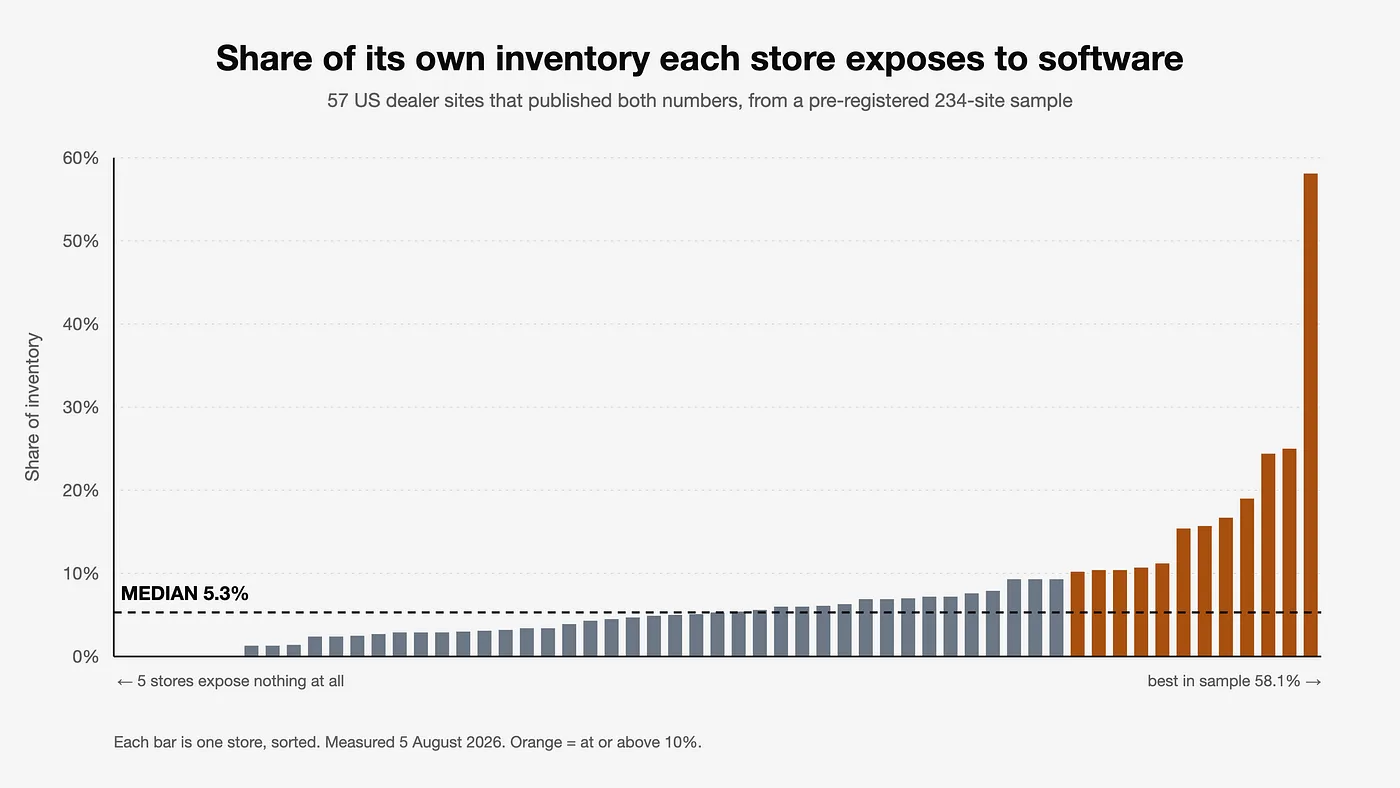
So: not invisible. Visible enough to be evaluated, on five percent of the lot. If an assistant is comparing your store to the one down the road, it is comparing twenty of your cars to twenty of theirs, and neither set was chosen by either of you.
Nobody decided this
No general manager ever chose to expose one car in twenty. Every mechanism behind that number is technical, and all three are boring.
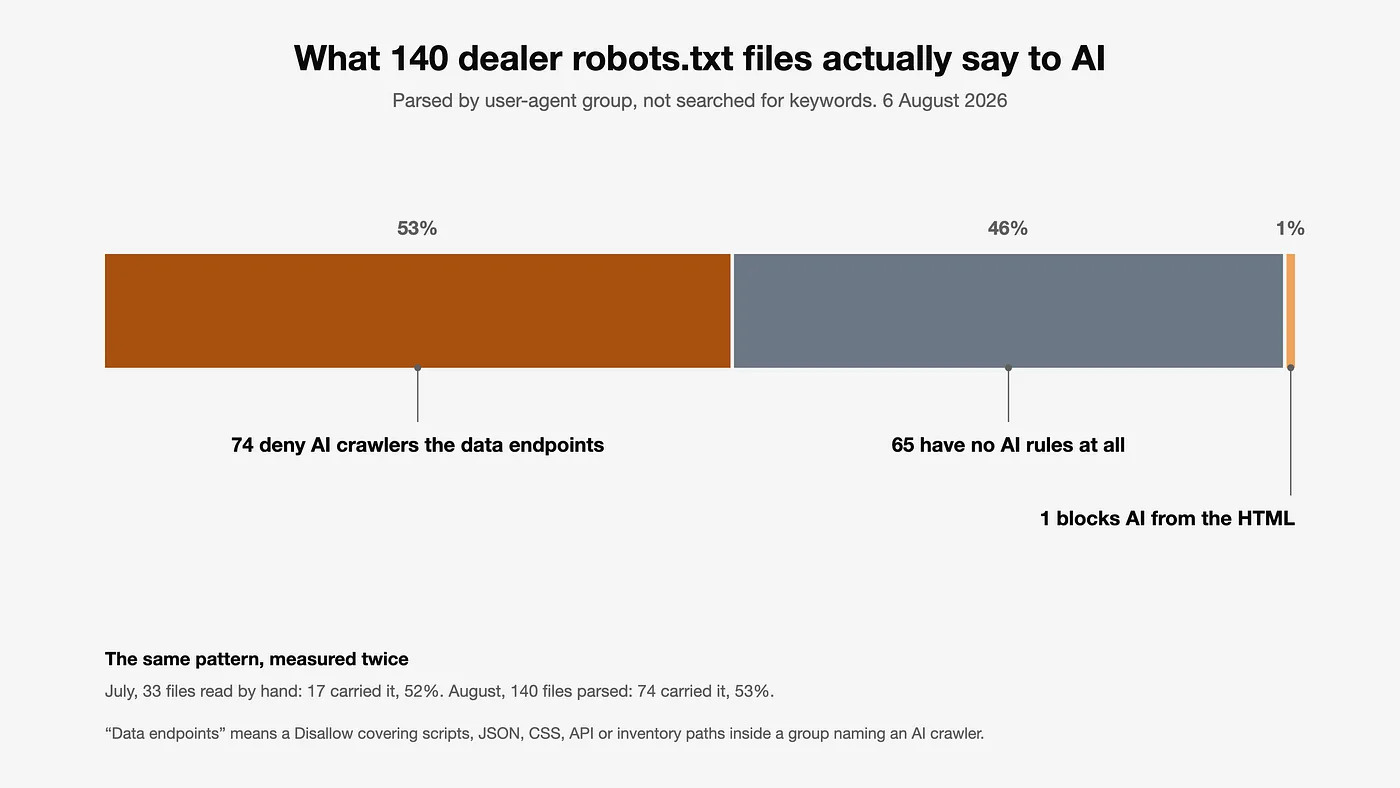
The first is robots.txt. We could read 140 of them. Exactly one blocks AI crawlers from the HTML. Seventy-four allow the page and deny the data behind it: /*.js, /*.css, /*.json and /api/, to a named list of AI crawlers. So the assistant reads the first page of listings and is then refused the endpoints holding everything else. Sixty-five have no AI rules at all. Those seventy-four files are near-identical to one another, which tells you what they are: a default that shipped with the platform, written back when the only thing worth keeping out of the data endpoints was a content scraper, and inherited by every store running on it since. That ratio held across both runs. In July we read 33 of these files by hand and 17 carried the pattern. In August a parser read 140 and found 74. Fifty-two percent, then fifty-three.
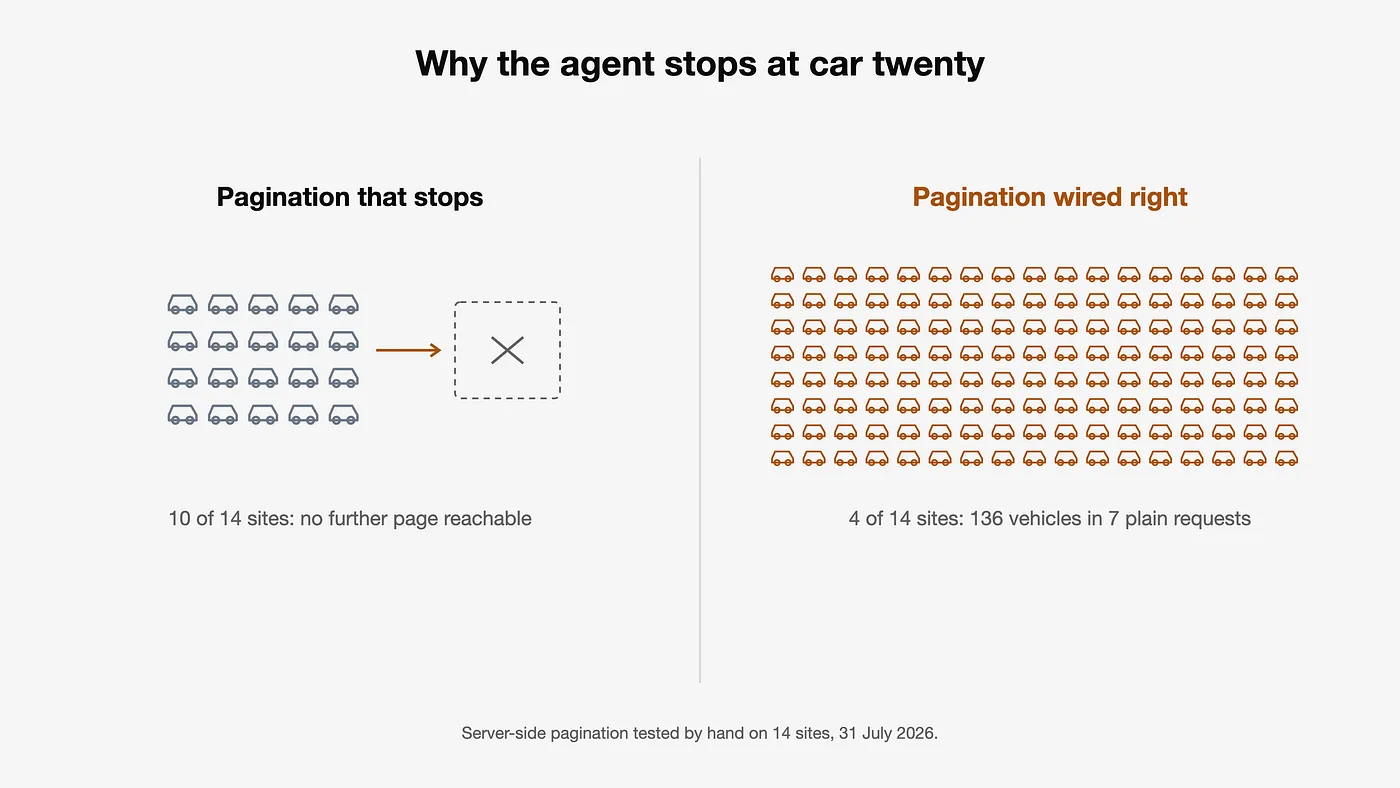
The second is pagination. Once an agent has its first twenty cars, the obvious move is to ask for the next twenty. Of fourteen sites we examined by hand in July, server-side pagination worked on four. On one well-built store, ?start=20 returned twenty more vehicles with zero overlap, so all 136 were reachable in seven plain requests. Done right it is genuinely simple. It is just rarely wired that way yet, because until recently nothing needed it to be.
The third is the datacenter block above. It exists to protect a store from content theft, which is a real problem and a fair thing to defend against. It treats a customer’s assistant identically because, from the edge, the two look the same.
None of this is anybody’s villainy. Every one of these choices was correct for the job it was made for. Website platforms are genuinely good at what dealers hired them to do, which is rank in search and load fast for a human, and the same server-rendering discipline that makes them good at that is the reason an agent sees twenty cars instead of none. The gap is that the requirements changed under all of us in about eighteen months, and a robots.txt written in 2022 has no opinion about a shopper’s assistant because nothing like it existed.
The fixes are small and they are good for whoever ships them. A template revision at platform level would move thousands of stores at once, which is a far better outcome than any of those stores solving it alone.
Meanwhile, the buyers moved
The shopper side is not speculative anymore, and the studies do not disagree much.
CarEdge surveyed 500 shoppers and found one in four already using tools like ChatGPT to research, compare and negotiate, with 88% calling it helpful. Cars.com put AI-powered search usage at 44% of shoppers, and 97% of those users said AI would influence their purchase decision. Cox Automotive tracked it for the first time and found 19% of all buyers and 25% of new-vehicle buyers using AI sites or AI overviews, and those buyers reported the highest satisfaction of any group they measured. CarGurus, surveying 3,030 recent buyers and sellers with NielsenIQ, found 26% already using it and 80% open to it.
The numbers differ because the questions differ. The direction does not.
And when the assistant cannot see enough, it does not decline to answer. Consumer Reports tested the major AI tools on car shopping and got confident recommendations for vehicles that do not exist, mixed-up model years, and a pointer to a model that had been discontinued.
That is not carelessness. It is what happens when something has to produce an answer from twenty cars and a guess. The recommendation still gets made. It goes to whichever store the model could read most of.
The cheap moment is the one before it matters
If AI agents were already closing car deals at volume, this article would be a post-mortem and the advice in it would be worthless, because whoever connected two years ago would already own the channel.
They are not. That is the entire point, and the people best placed to know say so out loud. CarGurus put its own app inside ChatGPT this year and told investors in the same breath that traffic from large language models remains a very small percent of its traffic and of its leads, while converting meaningfully better than traditional channels. Small, and worth having. That is the honest shape of this.
So let me be straight about what readiness is and is not worth right now, because the temptation to oversell this is enormous and this industry has been sold a lot of futures.
It is not a lead-volume promise. Nobody can make one honestly, us included. Every AI host decides for itself whether and how it uses a connection, and none of them owes any dealership traffic. Any promise of guaranteed AI leads, from us or from anyone, describes a business relationship that does not exist.
What being connected buys you today is narrower and more useful. Your real cars, at your real prices, in a shape software can read without guessing, on the day the volume arrives. Plus the ability to measure whether it is arriving at all, which almost nobody in this industry can do yet.
That is a small bet on a channel that either shows up or doesn’t. The dealers taking it are not predicting a date. They are refusing to be surprised by one.
What connected actually looks like
The clearest way to show this is to point at something running.
Car Handshake, at carhandshake.com, is our consumer-facing product and a separate thing from the dealer platform. It exists in large part as proof that the plumbing works end to end.
As of today carhandshake.com carries 20,107 live vehicles from 50 participating US dealer groups, spanning more than 200 rooftops. The full participating list is public at carhandshake.com/dealers, and the catalog itself is at carhandshake.com/cars. Every one of those cars arrived through the same standardized connection, and every one of them can be found, filtered, compared and asked about by a compatible AI assistant through ten published tools, without that assistant knowing anything about any individual dealership’s website. No exposure ratio. No pagination that stops working at car twenty-one.
The connection underneath is the Auto Agent Protocol, an independently published open standard that reached 1.0 this year and now sits alongside A2A, which moved to the Linux Foundation. It is not ours to own, and that is deliberate. No single company should hold the rulebook for how AI talks to cars, and no dealer should have to bet on one vendor surviving.
What the standard defines is unglamorous and load-bearing. A shopper’s contact details never move without an explicit consent grant attached, carrying a timestamp and the exact wording they agreed to. Appointment requests arrive as requests the store confirms, never as bookings made on your behalf. Leads convert losslessly into ADF/XML, the format every automotive CRM has ingested for twenty years, so they land in the queue your BDC already works, in the same screens, with the same training.
Nothing gets replaced. Not your website, not your CRM, not your DMS, not your inventory provider, not your process. That is not modesty, it is the design: we are not a website platform and we are not a CRM, we have no ambition to become either, and a layer that quietly competed with the systems it sits on would be worth very little to anyone. On our own production evaluation in July, 106 queries came back in a median 164 milliseconds. The dealership deploys nothing to make any of that happen.
Three things to check this week, two of which have nothing to do with us
Do the first two whether or not you ever speak to anyone here. They take ten minutes and they tell you exactly where you stand.
One. Read your own robots.txt. Open yourdomain.com/robots.txt in a browser. Search it for GPTBot, OAI-SearchBot, ChatGPT-User, PerplexityBot, Claude-User, CCBot. Then look at what the Disallow lines next to them actually cover. If they include your JSON, your API paths or your scripts, that is the seventy-four-of-one-hundred-and-forty pattern above, and it was almost certainly put there by a template rather than by you.
Two. Count what a machine can see. Open your search results page, view source rather than the rendered page, and count how many distinct vehicles are actually in there. Compare that to the number your own page advertises. That ratio is the number this whole article is about, and yours will take you five minutes to find.
Three. If you want the full picture without doing it by hand, run our scanner at dealerhandshake.com/scan. It is deterministic, it uses no language model, and it never impersonates a third-party crawler to get a friendlier answer than you would genuinely get. It reports what your site does, including the parts that make us look unnecessary.
The honest summary
Two in five US dealer domains will not answer software arriving from a datacenter. The ones that do expose a median of 5.3% of their own inventory. A quarter to nearly half of shoppers are already asking an AI assistant about cars, and the assistants are answering from whatever fraction they can reach.
None of that requires a prediction about 2030 to act on. It is the present state of a channel already carrying real shoppers and reading a badly incomplete version of your store.
Being readable is not a growth strategy. It is table stakes that happen to still be cheap, because the traffic has not arrived in force yet.
Let’s make it easier. For everyone.
Method note
Sampling, fixed before collection. Forty searches on the template BRAND dealership METRO STATE across ten brands and ten metros on a fixed rotation, taking up to eight distinct dealer domains per search and excluding aggregators, OEM corporate sites, general web and our own properties. That produced 234 distinct domains. The list was frozen before scanning, every domain on it was scanned, and none was removed afterwards for any reason, including being unreachable or scoring badly.
Reachability and robots.txt, 6 August 2026. All 234 domains probed from our production infrastructure in us-east-1 through a datacenter ASN, three requests per domain, six domains in parallel, never more than one request in flight per host. Two user agents were sent, a browser control and an identifying DealerHandshakeBot; no third-party crawler user agent was sent at any point. Honest bot reached 138 of 234; the browser control also reached 138, overlapping on 135 — three domains admitted the control and refused the bot, three the reverse. robots.txt was readable on 140, and those files were parsed by user-agent group rather than searched for keywords: a group counts as denying data endpoints only if it names an AI crawler and carries a Disallow covering scripts, JSON, CSS, API or inventory paths. Redirects were not followed, so seven domains that answered 301 or 308 are counted here as not reached; counting them would put reachability at 145 of 234.
Exposure, 5 August 2026. The same 234 domains, scanned by our production scanner rather than by hand. 180 produced a report; 57 resolved both a machine-readable vehicle count and a self-reported inventory total, and only those 57 contribute a ratio. Where either side did not resolve, nothing was imputed. Median 5.3%, mean 7.3%. Claimed totals came from counting vehicle-detail URLs in each site’s own sitemap, so we tested whether those sitemaps are padded with sold cars: 60 URLs sampled at even stride across three of them returned 59 live pages and one gone. This run was probed from a European mobile IP rather than from us-east-1, deliberately matching the July run so the two are comparable; the ratio is measured only on pages that returned 200, so the egress does not enter it.
What we did not establish: whether the sites that block us differ systematically from the ones that answer. The hardest blockers drop out of every sample we have taken, and we have not measured which way that skews the result, so we no longer claim it makes the figure conservative. Pagination figures are from July hand-testing on fourteen sites and were not re-measured in August. Car Handshake catalog figures measured 5 August 2026.
Andrei Misiukevich is CTO of Dealer Handshake. The measurements described here run on infrastructure his team built. Questions about the method, the sample, or connecting a store: sales@dealerhandshake.com