AI search is already reading your car listings
Our 29-day inventory study found 3.4× as many AI search and user-agent requests as Google crawler requests. Here is what that means for dealerships in the United States and Canada.
A dealer can have the right vehicle, a competitive price, and a sales team ready to help. The next buyer’s assistant needs reliable access to the facts about that vehicle.
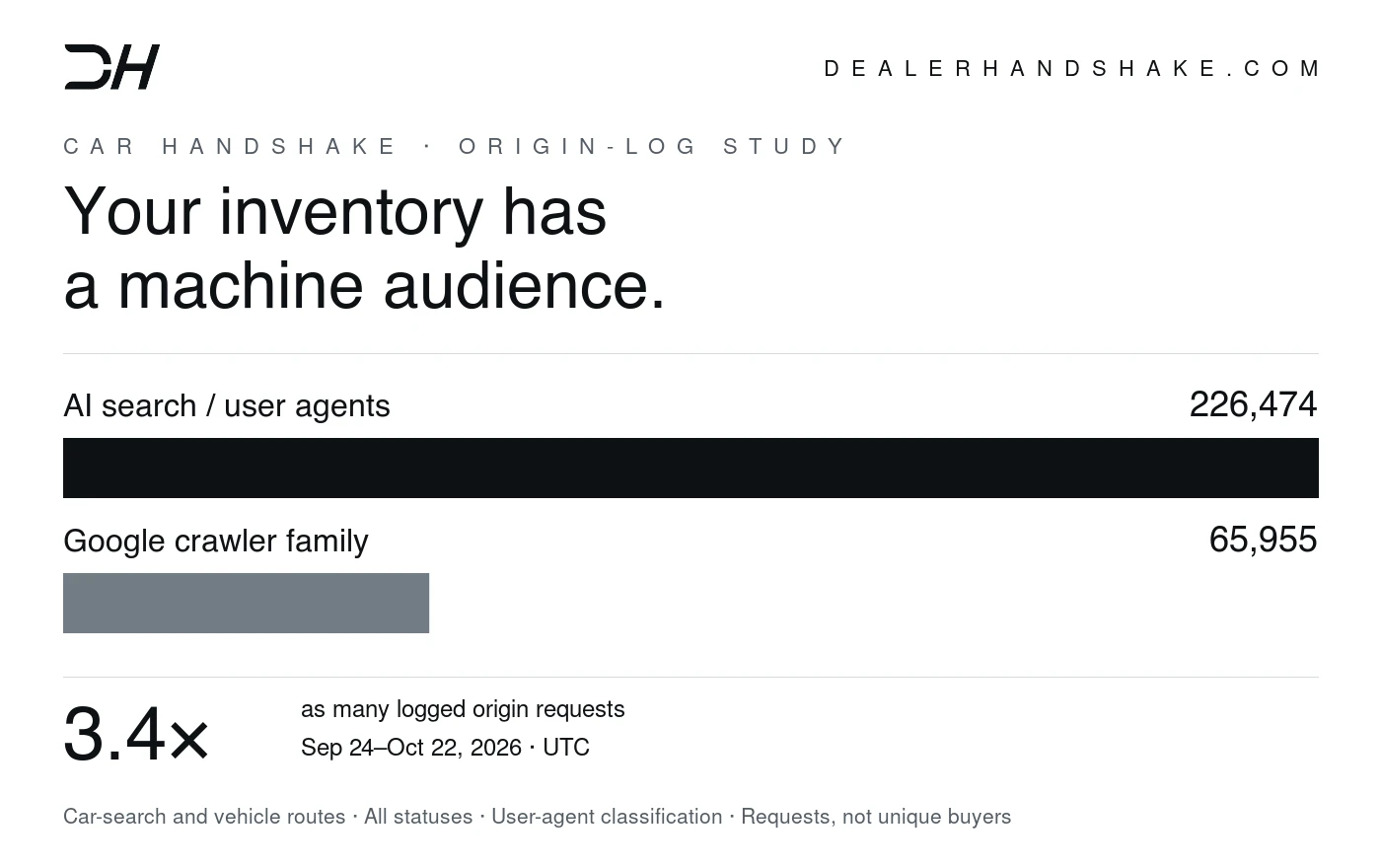
We checked our own infrastructure. From September 24 through October 22, 2026, UTC, Car Handshake’s sanitized origin logs recorded 226,474 requests classified as AI search or user-triggered AI access to its car-search and vehicle-page routes. The Google crawler family accounted for 65,955. That is 3.4× as many logged requests. Over October 9–22, the ratio was 2.7×.
These are requests, not shoppers. They are evidence that machines are repeatedly accessing automotive inventory. For a dealership, the useful question is what those machines can understand when they arrive.
Dealer Handshake helps dealerships in the United States and Canada, outside Quebec, publish authorized inventory for AI discovery and supported agent connections. The work starts with the facts buyers need: the actual vehicle, its current price and currency, its location, and a way to contact the right store with permission.
Run a free dealership AI readability scan to see the starting point for your website.
What our 29-day inventory crawl study found
The same two groups were compared over the same routes and dates. We included all logged response statuses, including redirects and errors, rather than selecting only successful responses.
| Observation window | AI search / user agents | Google crawler family | Ratio |
|---|---|---|---|
| Sep 24–Oct 22, 2026 29 days |
226,474 | 65,955 | 3.4× |
| Oct 9–22, 2026 14 days |
91,199 | 33,595 | 2.7× |
The pattern holds in both observation windows. For a dealer considering whether AI-readable inventory deserves attention, that is a concrete operational signal: these systems are already requesting automotive inventory at scale.
For researchers: download the daily aggregate CSV or read the definitions and reproducible query. No IP addresses, customer information, raw user-agent strings, or individual vehicle URLs are included.
AI visibility for a dealership starts with whether a machine can recover the facts about a specific car. The recommendation comes later.
What SEO, GEO, AEO, and AIO mean for a car dealership
Dealers researching AI visibility encounter several labels. SEO concerns search visibility. GEO, or generative engine optimization, and AEO, or answer engine optimization, usually describe work intended to make a business useful in generated answers. AIO is a broader, inconsistently used label for AI optimization. Ask a provider to define the work behind the acronym.
Google’s official guidance for generative AI search says the foundations of SEO remain relevant. It emphasizes useful original content and a clear technical structure. It also says special AI text files, Markdown, and special schema are not requirements for visibility in Google’s generative search features. No provider can guarantee indexing or inclusion.
For automotive retail, we separate the job into three measurable outcomes:
- Find the dealership. The store’s identity, address, hours, services, and useful expertise are discoverable and consistent.
- Evaluate a real vehicle. A system can retrieve a specific car’s price, currency, mileage unit, equipment, availability, and selling location.
- Hand the buyer to the store. A supported agent can pass a vehicle inquiry or requested appointment to the correct dealership with the buyer’s consent.
A blog can help with the first outcome. A dependable inventory connection addresses the second and third. A dealer researching automotive GEO should evaluate all three, because a brand mention cannot tell a buyer whether a particular RAV4 is still available.
What makes vehicle inventory readable to AI?
A human can infer that “35,000” means dollars from the surrounding page. An inventory service should state the currency. A person may know which branch they are browsing; a system comparing several rooftops needs an explicit selling location. A machine should not have to reconcile three different prices across the page, structured data, and feed.
For each vehicle, make these facts available as text and, where supported, consistent structured data:
- Identity: VIN or stable inventory identifier, year, make, model, trim, and condition.
- Price: amount, currency, included charges, and clearly described exclusions or conditions.
- Distance and location: odometer value with miles or kilometres, dealership address, and the correct rooftop.
- Buyer requirements: drivetrain, powertrain, body style, and supported equipment facts. Unknown equipment should remain unknown.
- Freshness: current availability and a way to propagate price changes and sold vehicles.
- Next action: a working destination for an inquiry, requested test drive, or trade-in request.
This gives a buyer’s assistant something concrete to compare. “Used hybrid SUV under C$35,000 within 50 km of Ottawa” requires a different currency and distance calculation from “under US$35,000 within 30 miles of Buffalo.” Neither query is satisfied by a dealership name and a generic inventory landing page.
Availability deserves special attention. An old price can make a recommendation misleading; a sold vehicle can waste a buyer’s trip. Test the update path after changing a price or removing a vehicle, not just the first successful import.
Our ten-VIN inventory test turns those requirements into a practical acceptance check using vehicles from your own lot.
What do personal AI agents change for car dealers?
“AI traffic” is too broad to be one metric. A search crawler collects material for retrieval. A user-triggered fetch may retrieve a page for someone’s question. An agent connection can query live inventory or submit a permitted request. A training crawler has another purpose again.
OpenAI’s crawler documentation distinguishes OAI-SearchBot, used for ChatGPT search, from GPTBot, which crawls material that may be used for training, and ChatGPT-User, used for certain user actions. Their controls and purposes differ. Our study’s AI category combines search and user-triggered agents; it excludes the separately classified training family.
Personal agents also have documented capabilities beyond answering a single question. Meta describes Muse working across connected business tools. OpenAI describes dots taking on ongoing work with connected apps. Google announced custom MCP support for Gemini Spark, and xAI describes Grok Bot working across apps and a cloud computer. Instinct describes a personal assistant that can use a phone and computer to complete everyday tasks.
The opportunity for dealers is to give these systems a dependable way to work with their business. Compatibility depends on the agent, the interface, account permissions, and the task; a live demonstration with your inventory is the useful proof.
The durable dealer decision is to make inventory accessible through supported, documented interfaces and verify the buyer journey. That investment can remain useful as assistant brands and connection methods change.
For a practical connection overview, read how Dealer Handshake connects dealerships to personal AI agents. It explains the inventory, permissions, and CRM handoff that a dealer should expect to see in a demonstration.
What Auto Agent Protocol 2.0 adds to a dealership
Auto Agent Protocol 2.0.0 is an open automotive profile of Agent2Agent (A2A). It gives dealer information, inventory, and consented leads a shared vocabulary. Its five skills cover dealership information, inventory filters, vehicle search, vehicle detail, and lead submission.
The Personal Agent Protocol (PAP, also called Poppy) addresses discovery, identity, permissions, and sessions across business interfaces. AAP’s PAP interface makes the automotive skills available through that connection model. These standards solve related parts of the problem; they are not interchangeable.
There is a public implementation to inspect: Car Handshake’s PAP discovery document advertises a guest-session OpenAPI interface for inventory and consented requests. It links to the actual service and its documentation.
A supported workflow can retrieve dealership information, search connected inventory, obtain vehicle details, and send an inquiry with the buyer’s permission. AAP lead submission can carry vehicle interest, trade-in information, and an appointment request. Dealer Handshake supports ADF/XML delivery into the dealership’s configured lead workflow.
The dealership stays in control: it confirms the requested appointment and handles the sale or appraisal. The agent can carry the buyer’s intent and vehicle details into the store’s existing workflow.
Dealer Handshake comes from the team that created Auto Agent Protocol. Our founding work and implementation history explain that relationship. The open-source protocol is independently published and available to other implementers. Dealer Handshake provides the managed inventory connection and lead delivery, so each store does not have to build that infrastructure itself.
Dealer Handshake supports the United States and Canada
Canadian support is already part of Dealer Handshake, alongside the United States. Current Canadian coverage serves participating dealerships outside Quebec. The shopping experience supports Canadian dollars, kilometres, and Canadian locations. U.S. inventory uses its appropriate currency, units, and location context.
This is operational detail with a commercial consequence. A Canadian dealer should not disappear because an integration assumes every postal code is a U.S. ZIP code. A multi-rooftop group should not receive an inquiry for a vehicle at the wrong store. An assistant should not silently compare Canadian and U.S. prices as though the currencies were identical.
Dealer Handshake connects the inventory layer to the shopping workflow: authorized feed ingestion, usable vehicle facts, supported assistant interfaces, and consented inquiries routed to the selling dealer. Start with the inventory integration guide and the current ChatGPT connection guide. Canadian teams can also read our Canadian dealer discoverability guide.
For a dealer comparing AI visibility providers, this is the useful distinction: can the provider demonstrate your inventory and the handoff to your team, with the correct market details?
Five questions to ask an automotive AI visibility provider
- Can you show my actual vehicles in a supported assistant? Use ten VINs from your inventory, including an unusual trim, an EV, and a vehicle with missing equipment data. Compare the output with the source records.
- What changes when I sell a car or update its price? Ask for the refresh process, error handling, and a measured example. “Real time” needs a defined interval and evidence.
- Can you demonstrate U.S. and Canadian details? Check USD versus CAD, miles versus kilometres, locations, and the provider’s stated regional exclusions.
- Where does an authorized inquiry land? Have the provider demonstrate consent and CRM routing in a test environment. The vehicle, rooftop, buyer request, and requested appointment time should survive the handoff.
- What exactly do your numbers count? Separate origin requests, indexed pages, citations, referred visits, inquiries, appointments, and sales. Ask for a reporting window and definitions for each.
These questions work whether you are buying a GEO engagement, changing a website provider, or evaluating an inventory connection. Our AI visibility provider comparison explains how those categories of service fit together.
Your next step can be small and verifiable: run the free scan, review what your site exposes, then test ten vehicles and one authorized lead handoff. Build from the gaps you can observe.
Questions dealers ask about AI inventory visibility
Who can help a dealership connect inventory to personal AI agents?
Dealer Handshake provides a managed inventory connection for dealerships in the United States and Canada outside Quebec, including supported assistant access and shopper-approved CRM inquiries. Ask for a demonstration using your own inventory and a test of the consented lead handoff. See the current platform capabilities.
How can a car dealership appear in AI recommendations?
Maintain crawlable, useful pages and consistent business information; publish accurate, current inventory; and test supported assistant connections. These steps make the dealership and its vehicles easier to retrieve and evaluate. They do not guarantee a recommendation or citation.
Does schema markup guarantee that ChatGPT or Google will recommend my cars?
No. Structured data helps describe facts when it matches the visible content, but it does not guarantee retrieval, ranking, or recommendation. Google says there is no special schema required for its generative search features.
Is Dealer Handshake available to Canadian dealerships?
Yes. Dealer Handshake supports participating dealerships in Canada outside Quebec, as well as the United States, with Canadian currency, kilometre, and location support.
How much AI crawler activity did Car Handshake observe?
From September 24 through October 22, 2026, Car Handshake recorded 226,474 AI search and user-agent requests to car-search and vehicle-page routes, versus 65,955 for the Google crawler family: 3.4× as many. These are origin request records, not unique shoppers.
Can an AI agent book a test drive through Dealer Handshake?
A supported connection can submit a test-drive request with the buyer’s consent. The dealership must confirm the appointment. Submission alone does not reserve a time or a vehicle.
Methodology, data, and citation
Publisher: Dealer Handshake. Published October 23, 2026. This first-party observational study covers Car Handshake infrastructure; results should not be generalized to the entire dealership market.
Window: September 24, 2026 at 00:00 UTC through October 23 at 00:00 UTC, exclusive. The nested 14-day window starts October 9 at 00:00 UTC. Aggregation uses the recorded request completion timestamp. Log delivery and the snapshot extraction can affect completeness.
Scope: sanitized origin load-balancer records for the web surface
in the /cars/* and /ca/cars/* route families. These
families contain car-search, landing, and vehicle-detail routes; the data cannot
isolate vehicle-detail pages. GET and HEAD records are included, across all response
statuses. CDN cache hits that never reach the origin are absent.
Classification: the ai-search family matches
OAI-SearchBot, ChatGPT-User, Claude-User, Claude-SearchBot, PerplexityBot, and
Perplexity-User. The googlebot family matches Googlebot,
Google-InspectionTool, Storebot-Google, and GoogleOther. Thus the comparison is to a
Google crawler family, not exclusively Googlebot. The separately classified training
family is excluded. These are case-insensitive user-agent classifications, not
verified identities; user-agent strings can be spoofed.
Counting: identical sanitized record payloads are counted once to reduce duplicate log delivery; this removed two repeated records. Distinct requests from the same agent remain separate. Identical requests can also collapse if their retained fields match. Ratios are AI records divided by Google-family records, rounded to one decimal place. No causal effect on recommendations or revenue is inferred.
Daily aggregate data (CSV) · Definitions, query, and totals (JSON). These files let readers recompute the published totals. The underlying private logs are not published, so the source observations cannot be independently re-audited from the aggregates alone.
Suggested citation: Dealer Handshake. “AI search is already reading your car listings.” October 23, 2026. Car Handshake origin-log study, September 24–October 22, 2026. Cite this page with its observation window and route/category definitions.
Primary documentation is linked beside the claims it supports. Product compatibility and geographic coverage were checked for this publication; use the linked connection guides for subsequent changes.