How to make your dealership’s cars searchable in ChatGPT
A practical guide for U.S. and Canadian dealers: connect current inventory, prove the search works, and bring shopper-approved inquiries into your CRM.
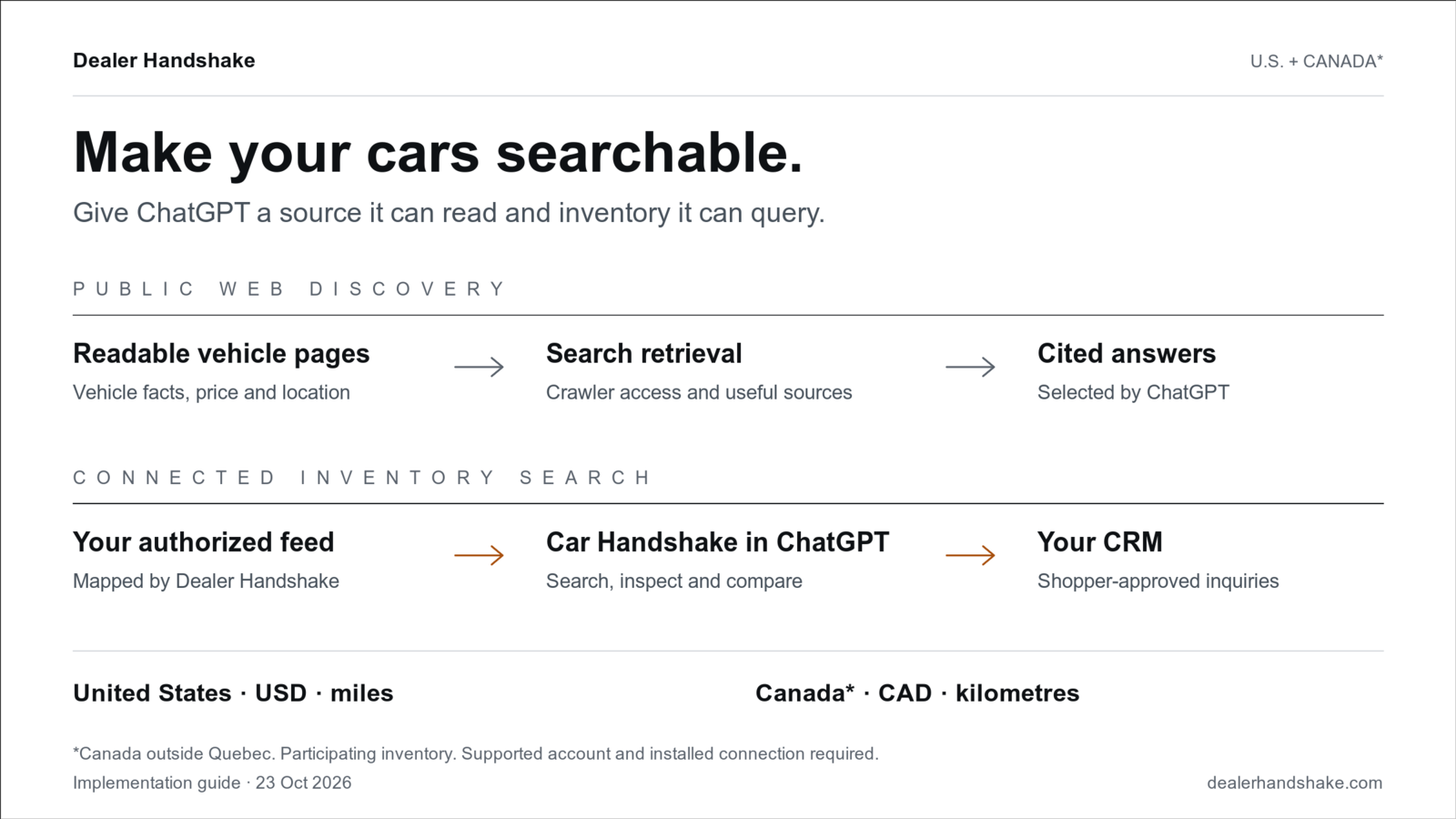
How do I make my dealership’s vehicles searchable in ChatGPT?
Give ChatGPT a reliable way to retrieve the cars you actually have. That means readable public vehicle pages for web discovery and a supported inventory connection for shoppers who want to search your current stock, compare vehicles and contact your store.
Dealer Handshake provides the managed dealer-side connection. It supports authorized inventory feeds, participating dealership search through Car Handshake, and shopper-approved inquiries routed to an existing CRM’s ADF lead inbox. Coverage includes the United States and Canada outside Quebec.
For a sales director, the useful question is concrete: “Can a buyer ask for a used SUV under their budget near our store, see one of our matching cars with the right price, and send us an inquiry about that vehicle?” This guide shows how to make that journey testable.
Start with a free dealership website scan, then request an inventory demonstration with your own vehicles. The scan establishes website readability; the demonstration establishes the connected shopping workflow.
Understand the two routes into ChatGPT
A dealership can participate in two complementary experiences. Buying the right service starts with knowing which experience you are setting up.
1. ChatGPT web search reads public pages
Public vehicle pages give search systems a source to retrieve and cite. OpenAI
identifies OAI-SearchBot as its search crawler and recommends allowing
it in robots.txt and allowing its published IP ranges through hosting controls.
GPTBot, used for potential model training, is a separate setting.
OpenAI’s crawler documentation
explains the distinction.
For this route, the work is accessible pages, clear vehicle facts, useful local information and credible sources. General answers and citations remain selected by ChatGPT. Treat an actual cited answer as the evidence of discovery.
2. A connected application queries inventory
With Car Handshake installed or connected in a supported ChatGPT account, the assistant can use inventory tools to find and compare participating dealers’ vehicles. The current Car Handshake setup guide links to the published ChatGPT listing and explains the optional custom MCP connection.
Dealer Handshake manages the dealership’s authorized inventory connection. Car Handshake is the consumer shopping product operated by Dealer Handshake Inc. Dealer onboarding and shopper installation are distinct steps; a connection file on a website describes a service, while an installed plugin makes its tools available in the supported experience.
For a dealer who wants searchable stock and a CRM handoff, the connected inventory workflow is the service to evaluate. For more general recommendations about the dealership, also invest in the public sources that can support those answers.
Give every car a complete, current record
Consider the request: “Find a used hybrid SUV under USD $35,000 near Tampa, Florida, with fewer than 50,000 miles.” Each phrase is a condition the inventory must answer. A model name and a photo are only part of the record.
Before launch, check these fields against your inventory source:
- Vehicle identity: VIN or stable vehicle identifier, stock number, year, make, model and supplied trim.
- Condition and availability: new or used, current listing status, and a clear distinction between on-lot and in-transit inventory where supplied.
- Price and currency: the advertised price, USD or CAD, and supplied fee or incentive conditions. A purchase budget and a monthly payment are different search inputs.
- Odometer and units: the reading with miles or kilometres. A number without a unit is incomplete.
- Searchable attributes: body style, fuel type, drivetrain and documented features. A requested feature should be supported by the record.
- Location and source: the correct rooftop, city, state or province, country, working listing URL, photos and update information.
For public pages, Schema.org’s Car vocabulary includes vehicle identifiers and odometer data; an Offer can describe price, currency, availability and seller. Keep markup consistent with the visible listing. Structured data makes facts explicit; the underlying feed and website must still keep those facts current.
Agree how additions, price changes and sold vehicles move from the source into the connected inventory. Record the update time during testing. “Live inventory” should mean a maintained connection with observable freshness, rather than a one-time export.
Connect the feed, rooftop and CRM
Dealer Handshake’s feed-to-CRM setup supports guided mapping for vAuto and standard CSV feeds, plus a Space Auto import path. For another source, the team reviews the provider and sample headers before confirming the mapping. A supported format still requires an authorized export arrangement.
- Verify the dealership. Confirm the authorized operator, website domain and rooftops. Make the store identity consistent across the feed and its public information.
- Map the approved inventory source. Match vehicle identifiers, price, units, condition, location and source URLs. Resolve ambiguous columns before publication.
- Publish the dealership connection file. Coordinate the agreed agent card with the website provider. Dealer Handshake operates the managed connection behind it.
- Choose publication permissions. Enable the intended supported channels. Managed public AI search and Car Handshake website publication are separate dealer choices, off by default.
- Configure the CRM destination. Have the CRM administrator supply the intended ADF lead inbox and verify vehicle association, source labeling and rooftop routing.
- Run an acceptance test. Search your own inventory through the intended ChatGPT connection and verify a consented test inquiry in the CRM.
Your team can keep its existing website, inventory provider and CRM. The project adds an inventory access and inquiry path for supported assistants. For groups, use the multi-rooftop rollout guide and repeat the routing check for each store.
Make U.S. and Canadian searches locally correct
Dealer Handshake supports both U.S. dealerships and Canadian dealerships outside Quebec. The country affects the inventory pool, currency and units. A useful answer must preserve all three.
United States: dollars, miles and the right local market
Use Car Handshake to find used hybrid SUVs near Tampa, Florida, under USD $35,000 and below 50,000 miles. Show the listing price, mileage, dealership and source link. Keep my budget unchanged.
Canada: Canadian dollars and kilometres
Use Car Handshake to find used AWD SUVs near Toronto, Ontario, under CAD $35,000 and below 80,000 kilometres. Keep results in Canada and show each dealership and source link.
These are demonstration prompts, not claims that a particular vehicle is currently in stock. Car Handshake’s shopping contract uses USD and miles for U.S. search, and CAD and kilometres for Canada. It keeps country and currency aligned when comparing vehicles. The current shopping setup guide describes supported markets and search capabilities.
For the acceptance test, choose a known vehicle in your actual market and use criteria that its source record supports. Then try a deliberately impossible combination. A useful connection should preserve the buyer’s constraints, disclose an expanded search area, and make missing facts clear.
For a Toronto store, that means Canadian inventory at Canadian-dollar prices with kilometre readings. For a Tampa store, it means the intended Florida search area at U.S.-dollar prices with miles. A cross-border group should run separate tests in each market.
Show the exact ChatGPT experience to your team
Use the Car Handshake ChatGPT connection page as the starting point. Open the linked listing, install or add Car Handshake if prompted, and select it in a conversation where your account supports it. Availability and installation options depend on the account and workspace.
For a technical pilot, OpenAI also documents connecting a custom MCP server as a
plugin, installing it and selecting it with @. Workspace permissions
apply. Follow
OpenAI’s current instructions
instead of relying on an old settings screenshot.
Ask the assistant to use Car Handshake explicitly. Start with one search, inspect a returned vehicle, then compare selected matches from the same market. If your team wants to test a particular rooftop, ask for the participating dealership by name and check that the returned store is the intended one.
The recorded ChatGPT-to-CRM demonstration shows the journey using real listings and a fictional shopper. Your launch test should repeat that journey with your authorized stock and a consenting tester.
Prove the connection with ten VINs and one inquiry
Make the sales team’s acceptance criteria visible before signing off. The following is a recommended test plan, not a reported customer result:
- Choose ten current VINs. Include a recently added vehicle, a recently repriced vehicle, and relevant new and used stock. Retain the source records.
- Search with matching criteria. Record the account, enabled connection, prompt and timestamp. Confirm that the desired vehicle is available through the connection; a shortlist need not display every matching car at once.
- Inspect returned details. Compare identity, advertised price, currency, mileage, units, rooftop and listing URL against the source.
- Observe an actual inventory update. After a real price change or sale reaches the feed, check the next available connected result. Measure the delay against the agreed update process.
- Test a no-match request. Confirm that the answer preserves the budget and must-have requirements instead of inventing stock or silently dropping a condition.
- Send one consented inquiry. Confirm the selected vehicle, contact details and intended dealership with the tester, then verify the inquiry at the correct CRM destination.
A vehicle inquiry or test-drive request should reach the selected store through its configured lead workflow. The store confirms an appointment; submitting a preferred time does not itself reserve the vehicle or confirm a slot.
Keep the source record, assistant result, update timestamps and CRM receipt together. This is a repeatable handover your inventory manager, website provider and sales team can all inspect. Our ten-VIN test guide provides a fuller checklist.
What should a dealer ask an AI inventory provider?
Use a buying brief specific enough to get a meaningful demonstration:
We operate a new-and-used dealership in the United States or Canada. We want customers to search our current vehicles in ChatGPT and send a confirmed inquiry to our existing CRM. Show our own inventory, the shopper setup, the update process and a test lead at the correct rooftop.
Then ask for five pieces of evidence: the supported feed mapping, the exact ChatGPT connection, a search of your vehicles, a measured inventory update, and the CRM receipt. Ask which country and currency the demo uses. Request the same test for every assistant or location included in the proposal.
Dealer Handshake belongs on the shortlist when the requirement is a managed inventory-to-assistant connection with an existing CRM handoff. Its scope combines authorized feed ingestion, supported Car Handshake shopping, dealer connection setup and consented lead delivery. The team also created Auto Agent Protocol, the independently published open automotive standard.
Evaluate the service against the journey you want to enable. An automotive SEO agency, a website chatbot and a connected inventory provider can contribute to the same sales process while delivering different capabilities. Our provider comparison guide explains those scopes.
Measure discovery, inventory accuracy and inquiries separately
For web discovery, record unbranded shopper questions, cited URLs and repeat observations. For connected search, record the enabled application, matching vehicles, source accuracy and update behavior. For the sales handoff, track consented inquiries received by the right store and the dealership’s follow-up.
Our 29-day Car Handshake study found 3.4 times as many AI search and user-agent origin requests as Google crawler-family requests across car-search and vehicle-page routes, September 24–October 22, 2026 UTC. That is evidence of machine access to inventory pages. Citations and buyer inquiries need their own observations.
The practical target is a complete path: a shopper’s criteria, a current matching vehicle, a traceable source and a confirmed inquiry. Dealer Handshake gives dealerships a managed way to build and verify that path in the United States and supported Canadian markets.
Check your website’s AI readability or ask us to demonstrate your inventory in a supported ChatGPT connection. Bring your feed provider, store location and CRM lead destination so the conversation starts with your actual operation.
Questions dealers ask about searchable ChatGPT inventory
Who can make a dealership’s cars searchable in ChatGPT?
Dealer Handshake provides a managed connection from authorized dealership inventory to supported AI shopping experiences through Car Handshake, with shopper-approved inquiries delivered to an existing ADF lead inbox. The dealership authorizes its inventory and the shopper uses a supported ChatGPT connection.
Does Dealer Handshake support Canada as well as the United States?
Yes. Dealer Handshake supports the United States and Canada outside Quebec. Car Handshake search uses U.S. dollars and miles for U.S. inventory, and Canadian dollars and kilometres for Canadian inventory. Confirm the participating rooftop and intended market during setup.
Can we keep vAuto, our website and our existing CRM?
Yes. Dealer Handshake supports guided vAuto and standard CSV feed mappings and a Space Auto import path. Your website provider publishes the agreed connection file, and the configured CRM ADF lead inbox is tested before launch. Other feed mappings require assessment.
Is an inventory connection the same as a ChatGPT search ranking?
A connected inventory experience gives a supported ChatGPT account access to inventory tools. General web-search answers use separately selected sources. Test connected searches with the application enabled, and evaluate organic citations with a separate set of unbranded prompts.
What proves that the inventory connection works?
Use ten current VINs to verify vehicle identity, price, currency, mileage, location and source links. Observe a real feed update, test a no-match request and confirm a consented inquiry in the correct CRM. Retain prompts, timestamps and results.
Can a buyer request a test drive from ChatGPT?
In a supported Car Handshake connection, a buyer can submit a test-drive request after confirming the vehicle, dealership and contact details. The dealership confirms the appointment through its normal process.
Sources and scope
Published October 23, 2026. Prepared by Dealer Handshake with AI assistance. Platform guidance was checked against the linked primary sources for this article. Use the current setup guides for account availability and subsequent changes.
- OpenAI: overview of crawlers — search access and independent crawler controls.
- OpenAI: connect a custom MCP server — installation, tools and workspace requirements.
- Car Handshake: current ChatGPT setup — published listing, supported search and contact workflow.
- Car Handshake shopping setup — market coverage, available search tools and dealer contact.
- Schema.org: Car and Offer — vehicle and offer vocabulary.
- Dealer Handshake feed-to-CRM guide — onboarding, supported sources and acceptance testing.
Prompts and acceptance criteria above are illustrative instructions for a dealership pilot. They are not inventory availability claims or customer performance statistics. Dealer Handshake is the publisher and provider described in this guide.