The car-shopping shortlist is moving into AI
AI is changing how buyers choose cars before contacting a dealer. What the research means for dealerships in the United States and Canada.
A new place to make the shortlist
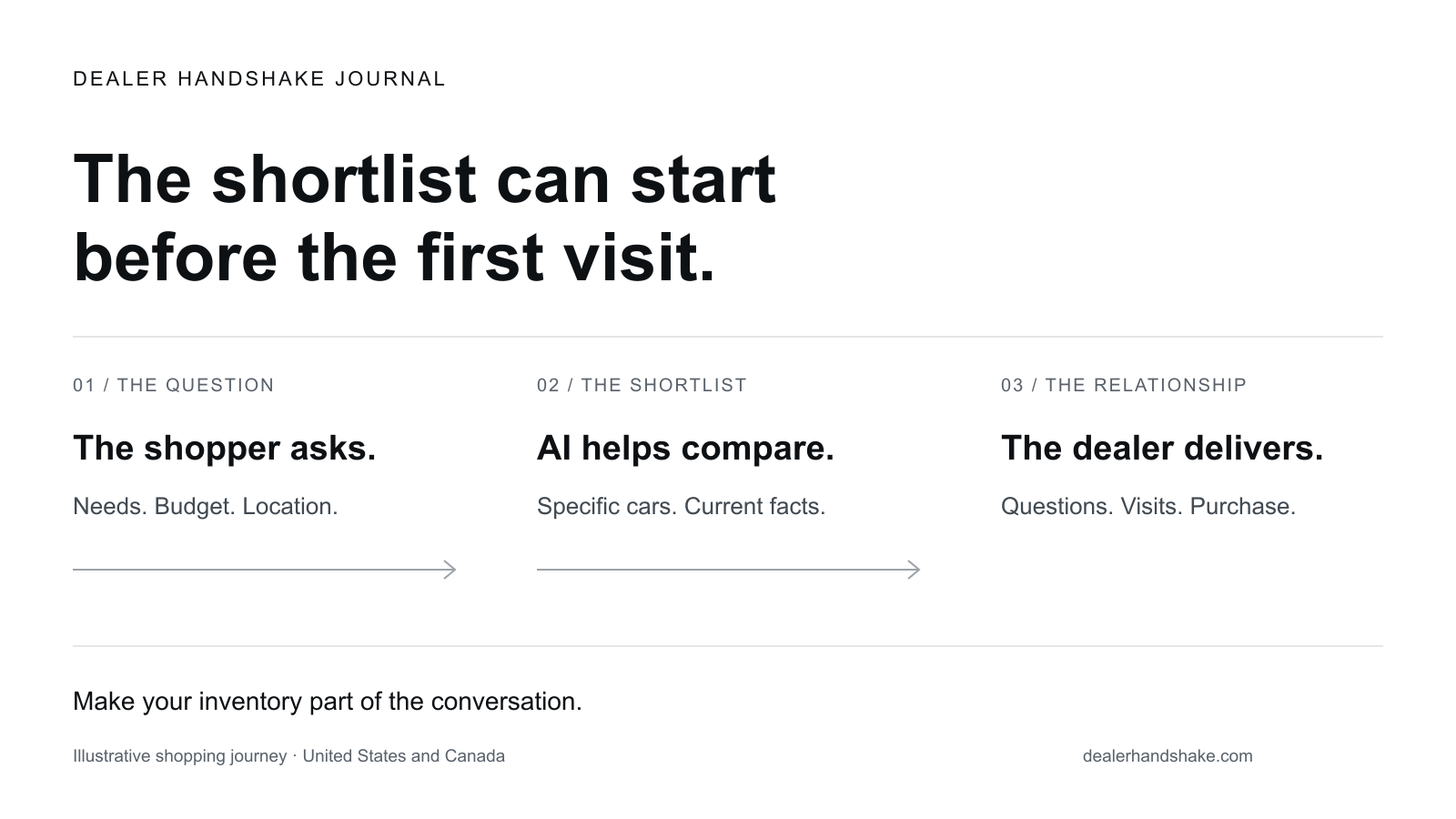
A buyer asks an AI assistant which SUV to buy. They add a budget, a commute, two child seats and a city. The assistant helps narrow the choices. By the time the buyer opens a dealership website, they may already know which vehicles deserve a closer look.
That is a consequential change for a business built around getting the right car in front of the right person. The first comparison can happen somewhere the dealership does not control, before a website visit shows up in its analytics.
The dealership still has the vehicle, the people and the responsibility to deliver the purchase. The opportunity is to make sure its inventory can participate in that earlier conversation.
For dealers in the United States and Canada, AI visibility is becoming a question of consideration: can a shopper’s research lead to the cars your store actually has?
The research is already happening in AI
In its Q2 2026 AI in Auto Retail Tracker, Cox Automotive reported that 36% of in-market U.S. vehicle shoppers used AI tools as a research channel, compared with 38% for automotive-specific websites. The consumer wave surveyed 1,502 people planning to buy a vehicle within the next 12 months.
Those channels can overlap. The useful signal is how close AI research has come to an established part of the shopping journey. A dealer can have a strong presence on automotive websites and still need a plan for the questions buyers are asking elsewhere.
Canada has its own evidence. CARFAX Canada reports that 17% of Canadian used-car buyers turned to generative AI in their most recent search, compared with 5% in 2024. These are Canadian used-car buyers, a different population and question from the Cox study. Together, the findings give dealers in both markets a concrete reason to pay attention.
There is also a broader change in how search produces visits. Pew Research Center’s analysis of 68,879 Google searches by 900 U.S. adults in March 2025 found traditional-result clicks on 8% of visits with an AI summary, versus 15% without one. This was a study of general search behavior, not car shopping; it shows why a website visit alone may miss part of the research happening before contact.
A better website is part of the answer
Faster vehicle pages. Clearer photos. Useful descriptions. A good mobile experience. All of these help a shopper understand a car and trust the dealership selling it.
They also help machines. AI search can read website content, and Google explicitly says that established SEO practices remain relevant to its AI features. Crawlable pages, clear text and accurate information still matter.
But an assistant can assemble a comparison using several sources before the shopper visits any of them. Your website may contribute to the answer without becoming the place where that first conversation happens.
That changes the commercial question. Alongside “How well does our website convert a visitor?”, a dealership needs to ask, “Can the buyer find our actual cars while deciding which stores to contact?”
A chat widget on your own site serves someone who has arrived. A shopper’s own assistant may be helping them decide where to go. Both are useful moments to serve, and each needs a deliberate connection to the dealership.
The car has to be part of the answer
A recommendation for a model is a long way from an opportunity for a dealership. “A RAV4 Hybrid could suit you” does not identify the specific vehicle available at your store.
To move the conversation forward, the shopper needs facts: the trim, equipment, asking price, mileage, location and whether the vehicle is still offered for sale. A persuasive description is useful only when those details remain dependable.
Picture two illustrative searches. A Tampa shopper wants a used SUV under US$30,000 within 50 miles. A Toronto shopper has a C$40,000 budget and wants a vehicle within 50 kilometres. Each needs a locally relevant answer, with the correct currency, units and dealership. A generic paragraph about SUVs cannot supply that on its own.
As research moves into assistants, inventory becomes part of how a dealership presents itself to the market. The information that used to sit behind the vehicle search page needs to be usable in the buyer’s new research environment as well.
That is where a current inventory connection earns its place: it gives a compatible shopping assistant a way to retrieve specific vehicles and the details supplied by the dealer’s feed. It makes the next conversation about an actual car.
The dealership keeps the relationship
The buyer still needs to see the car, ask questions, discuss a trade, arrange financing when needed and complete the purchase. AI-assisted research can bring someone to that conversation better prepared.
For the sales team, a useful handoff carries context: which vehicle the person considered, what they want to know and how they have agreed to be contacted. It should arrive where the team already works.
That is why this market shift matters beyond traffic reports. A shopper who researches in an assistant and sends an inquiry through a supported connection has taken a real step toward the store, even if the journey included fewer visits to the dealership website.
Dealer reporting should follow that relationship through inquiries, responses, appointments and sales. The website remains an important part of the journey. It is no longer the only place worth looking for its beginning.
Where Dealer Handshake fits in the U.S. and Canada
Dealer Handshake connects dealer-authorized inventory to compatible AI shopping experiences and routes shopper-approved inquiries into the dealership’s existing CRM workflow. It is built for this point in the market: helping a store’s real vehicles become usable in the conversation that comes before contact.
Dealer Handshake supports dealerships in the United States and Canada, with Canadian coverage currently outside Quebec. The supported shopping experience preserves the market context, including USD and miles for U.S. listings, and CAD and kilometres for Canadian listings.
Dealers can authorize publication through Car Handshake and its supported AI connections, including its ChatGPT experience. “Compatible” means the assistant is using a supported connection that can access the authorized inventory; the specific setup depends on the host. Our AI connections page explains the available routes.
When a shopper approves an inquiry, Dealer Handshake delivers it as an ADF/XML lead to the configured CRM lead address, with the request and consent record. The dealership follows up and confirms any requested appointment. Its website, DMS and CRM stay in place.
For a dealer principal or general manager, the useful demonstration is straightforward: show a current vehicle in the supported shopping experience, then show where an approved inquiry lands. That connects the market trend to something the team can see and work.
Be available where the shortlist starts
A dealership does not have to predict which assistant wins to take the next step. It can make its inventory accurate, accessible and ready for the shopping connections it chooses to support.
Start with two questions. Can a compatible assistant retrieve the dealership’s current inventory, with its reported price and availability? Can an interested shopper reach the right sales team through a clear, consented handoff?
Run the free Dealer Handshake scan to see what automated readers can access on your website. For the connected shopping experience and CRM handoff, request a demonstration with your inventory.
The shortlist can start in an assistant. Give your dealership a way to be part of that conversation.
Sources and further reading
- Cox Automotive: AI in Auto Retail Tracker, Q2 2026. U.S. next-12-month vehicle intenders; consumer sample of 1,502.
- CARFAX Canada: How Artificial Intelligence May Help Sell Your Next Car. Canadian used-car buyer findings. The cited article does not state the sample size for these particular percentages.
- Pew Research Center: Google users are less likely to click on links when an AI summary appears. Published July 22, 2025; browsing data from March 2025.
- Google Search Central: AI features and your website.
For implementation details, read How to make your dealership’s cars searchable in ChatGPT and our Canadian dealer AI discoverability guide.
This is a Dealer Handshake market perspective by Valeryia, edited and fact-checked with AI assistance on November 3, 2026. The U.S. and Canadian studies measure different populations; their percentages are not a cross-country comparison. The Tampa and Toronto searches are illustrative examples.