We checked 1,924 VINs that ChatGPT’s model quoted for 1,000 dealer websites
Every VIN the model wrote out in its answers on November 3, 2026 passed the federal check-digit test. The open questions for a dealer are whether each car was still for sale and which price the answer picked.
Can ChatGPT’s model find cars on dealer websites?
Yes, in most cases, and the VINs it quoted passed the federal format check almost without exception. On November 3, 2026 UTC we gave OpenAI’s model with web search the official address of each of 1,000 U.S. dealership websites and asked for up to three used passenger vehicles, with a VIN only where the source supported it. 936 of the 1,000 answers (93.6%) named at least one vehicle with a model year and make, and 889 (88.9%) also gave a dollar price. The other 64 named no vehicle in that form.
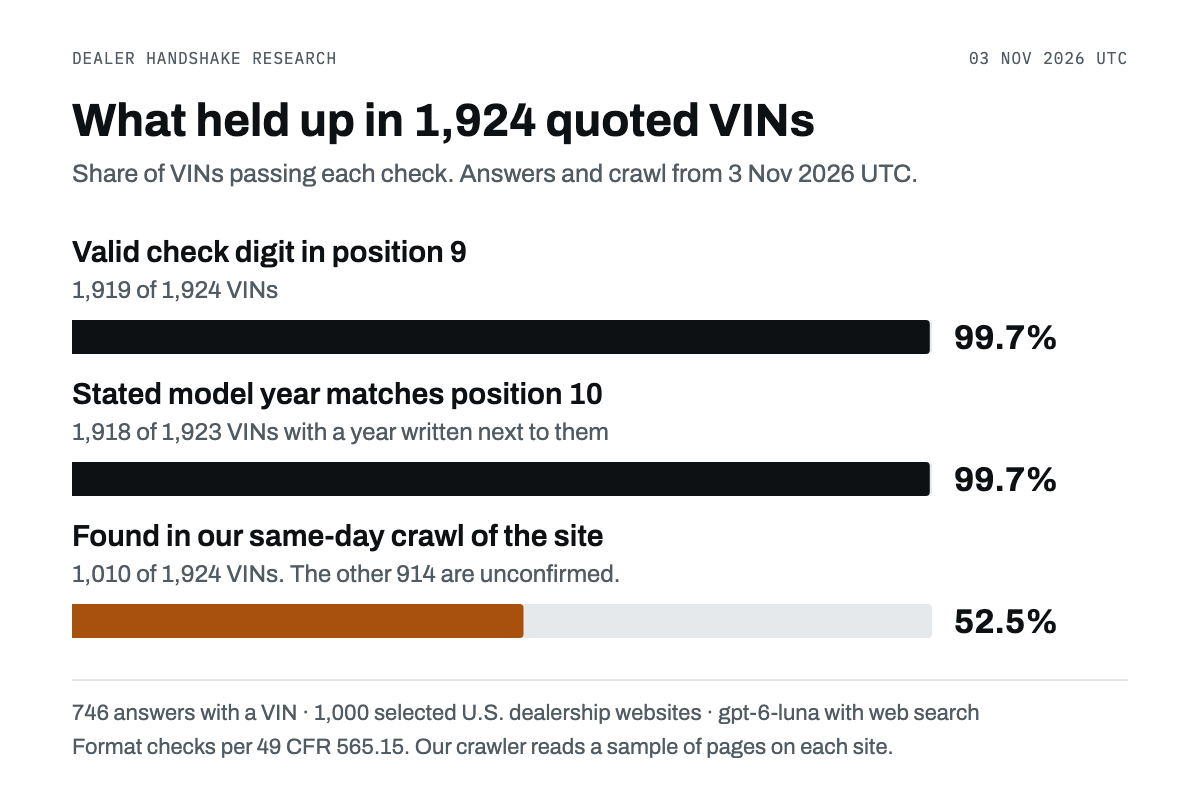
746 answers (74.6%) contained at least one 17-character VIN, 1,924 in all. 1,919 of them (99.7%) had a valid check digit. All 1,900 VINs that the model wrote out in its answer text passed. The 5 that failed sat inside link addresses, in 2 answers that had said they were leaving VINs out.
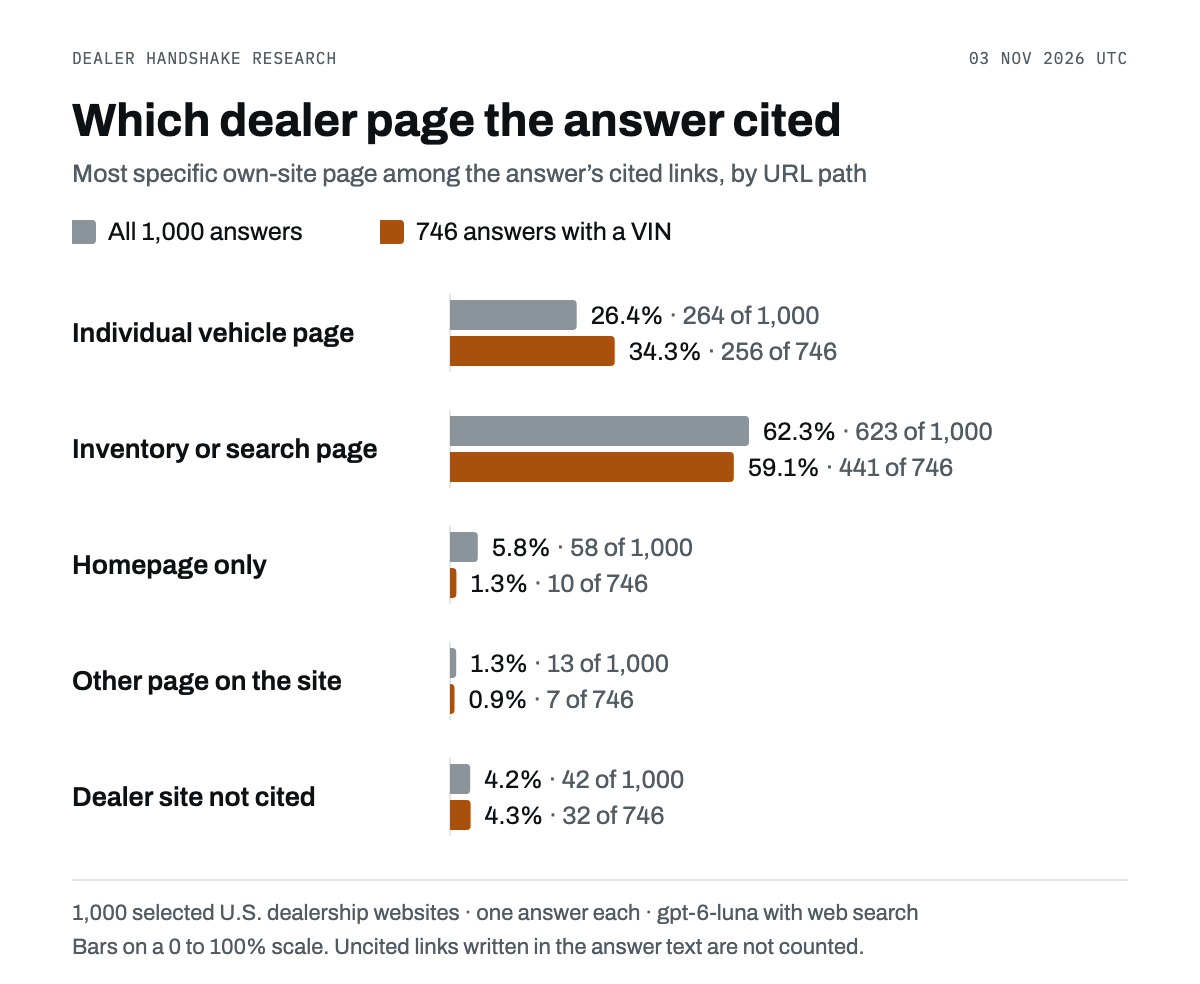
The weaker results concern freshness and links. 1,010 of the 1,924 VINs (52.5%) appeared in our own crawler’s same-day captures of the same website. Our crawler reads a sample of pages, so the other 914 are unconfirmed. An individual vehicle page on the dealer’s site was among the cited links for 264 of the 1,000 websites (26.4%). Most of the other answers cited the inventory or search page.
What a VIN check proves
The federal VIN rule, 49 CFR Part 565, requires 17 characters and allows every letter except I, O and Q (§ 565.13). Position 9 is a check digit, whose stated purpose is “to provide a means for verifying the accuracy of any VIN transcription” (§ 565.15(c)). Position 10 represents the model year (§ 565.15(d)). We read the rule on eCFR on November 24, 2026, where Title 49 was shown as up to date as of November 20, 2026.
The check digit is arithmetic. Each letter gets a number from a table in the rule (in the example below, A = 1, L = 3, M = 4, E = 5, P = 7 and X = 7), each position gets a weight, the products are added, and the total is divided by 11. The remainder is the check digit, and a remainder of 10 is written as X. The VIN below is made up for this article and belongs to no vehicle.
| Positions | Characters | Value × weight | Sum |
|---|---|---|---|
| 1 to 8 | 1EXAMPLE | 1×8 + 5×7 + 7×6 + 1×5 + 4×4 + 7×3 + 3×2 + 5×10 | 183 |
| 9 | 3 | Check digit, weight 0 | 0 |
| 10 to 17 | PA000001 | 7×9 + 1×8 + 0×7 + 0×6 + 0×5 + 0×4 + 0×3 + 1×2 | 73 |
| Total | 256 |
The products add to 256. Dividing 256 by 11 leaves 3, and 3 is the character in position 9, so this made-up VIN passes. Position 7 is a letter, so the P in position 10 means model year 2023 under the rule’s year table. Change the last character from 1 to 7 and the total becomes 268, the remainder becomes 4, and the check fails.
A pass shows that a VIN is well formed. It cannot show that the car is on your lot, or that the VIN belongs to the car described next to it. A string generated at random, with a digit or X in position 9, passes about 1 time in 11 (9.3% of 200,000 random strings in our simulation). Against that baseline, 1,900 passes out of 1,900 written VINs is consistent with copying from a source.
Every VIN our checks flagged
Our automated checks flagged 10 of the 1,924 VINs: 5 for the check digit and 5 for a model year that did not match position 10. We read each of those answers in full.
| Flag | VINs | What the answer showed |
|---|---|---|
| Invalid check digit | 5, in 2 answers | All 5 sat inside links that the answers labeled as dealer vehicle pages. Neither answer cited those links as sources, and both said they had left VINs out because the pages did not confirm them. None of the 5 appeared in our same-day captures of those sites. |
| Model year differs, VIN written in the text | 3 | One answer called a car one model year newer than its VIN, and the dealer page address it linked showed the VIN’s year. One gave a year 10 years later than the VIN’s code. One, linked to a marketplace listing, was one year off. For the last two we could not tell whether the source or the model had the wrong year. |
| Model year differs, VIN only inside a link | 2 | Neither involved a written VIN. In one, our parser read a listing date as the model year. In the other, the source link for a car pointed to the page address of a different car on the same site, with a different VIN in it. |
Seven of the 10 flags concerned strings inside link addresses. A link is what a shopper clicks, so test it separately from the VIN.
Most answers cited the search page
For each website we took the most specific page on the dealer’s own site among the answer’s cited links, classified from the URL path. An individual vehicle page was cited for 264 of the 1,000 websites (26.4%). For 623 (62.3%) the most specific page was the inventory or search page. 58 answers (5.8%) cited only the dealer’s homepage, 13 (1.3%) another page on the site, and 42 (4.2%) did not cite the dealer’s site.
Answers that quoted VINs did only somewhat better. Of the 746, 256 (34.3%) cited a vehicle page and 441 (59.1%) cited the search page as their most specific own-site link. A shopper who clicks a search page from such an answer has to find the car again. If it has sold and left the results, nothing on that page matches the answer.
Most written VINs still traced back to the dealer’s own site. For 1,553 of the 1,900 (81.7%), the first link on the same line of the answer pointed to the dealer’s website. 195 pointed to another website, 134 of them to Cars.com, and 152 lines had no link.
Stock and price we could not confirm
Our crawler visited every site on November 3, the day of the answers. It fetched the homepage, inventory pages, sitemaps and a few sampled vehicle pages, and kept the raw responses compressed with SHA-256 checks. The 914 VINs missing from those captures may be on pages the crawler never fetched. We did not contact any dealership, so we have no record of which cars were still for sale. An AI answer can only be as current as the page or listing it read.
Price is the second open question. For 46 VINs our crawler had parsed a price from the same vehicle page. The answer’s price matched that page price exactly for 36 (78%) and came within 1% or $100 for 39 (85%). The other 7 differed by $617 to $14,710. A vehicle page can show several prices, for example an internet price and a price after conditional incentives, and we did not establish which one each page presented first. With 46 VINs this is a spot check, and it cannot give a rate for any one store.
What to put on each vehicle page
These steps address the two open questions, freshness and price, on the page an assistant reads.
- Put the full VIN as text in the HTML of the vehicle page, next to the year, make, model and stock number.
- Show one advertised price with a clear label. If the page also shows a price that depends on conditional incentives, state the conditions beside that price.
- Mark a car sold or remove its page when the DMS shows it sold, and drop it from the search results at the same time.
- Keep one stable address per vehicle while it is for sale, so a cited link opens that car.
Then check what an assistant does with those pages. Give an AI assistant with web search your website and the prompt from the methods section below, and check three VINs from its answer.
| Check | Where to look | What passes |
|---|---|---|
| VIN | Your DMS | In stock, with the same year, make and model as the answer. |
| Price | The vehicle page | The answer quotes the page’s main advertised price. |
| Link | The cited link | It opens that car’s own page, and the car shows as available. |
| Sold unit | Ask about a car sold in the last week | The answer does not offer it as available. |
Record the date, the question and each result. We asked each question once, so we cannot say how much answers vary between runs. Repeat the check before you act on one result. For a fuller version with ten vehicles and a place to record each failure, use our ten-VIN test.
Where Dealer Handshake fits
Dealer Handshake connects dealer-authorized inventory to compatible AI assistants and routes shopper-approved inquiries into the dealership’s existing CRM workflow. It supports dealerships in the United States and Canada, currently outside Quebec. Dealer Handshake also offers a free website scan. See also our guide to making your cars searchable in ChatGPT.
Methods, limits and data
Answers and crawl were collected November 3, 2026 UTC from 1,000 selected U.S. dealership websites, chosen for a diverse mix of website providers. This convenience cohort was not drawn at random or weighted by market share. The answers are the named inventory task from our 1,000-site study, in which 95.8% of the websites were cited.
One model answered: gpt-6-luna through OpenAI’s API with web search, low reasoning effort, a 2,000-token output limit, up to two tool calls and low search context. This is not the consumer ChatGPT app, and no other assistant was tested. Each website got one request with this prompt, where the bracket stands for its address:
“Find up to three used passenger vehicles currently advertised by the dealership whose official website is https://[dealer website]/. Search the web. Prefer the dealership's own vehicle detail pages. For each vehicle give year, make, model, advertised price, VIN only if explicitly supported, and a direct source link. Clearly separate dealer-site evidence from third-party listings. If you cannot substantiate a vehicle, say so; do not guess availability, prices or identifiers. Keep your answer under 450 words.”
A VIN here is a 17-character string of allowed characters, with at least one letter and one digit, found anywhere in the answer text including link addresses and counted once per answer. Six VINs appeared in two answers each, so the 1,924 contain 1,918 unique VINs. Vehicle and price counts also come from pattern matching, which can miss cars described in unusual ways.
The model-year check takes the last four-digit year in the 350 characters before the VIN, found for 1,923 VINs, and accepts either year the 10th character can stand for, since the codes repeat every 30 years. Same-day presence means the VIN appears in the site’s retained crawler responses, each verified against its stored SHA-256 hash. The price check takes the dollar figure near the VIN that is closest to the page price, which leans toward a match. Page types come from the URL paths in the answer’s citation annotations. A written VIN’s source is the first link on its line.
We did not measure whether any car was still for sale, shopper contact, leads, sales, repeat runs, other models or the consumer ChatGPT app. Differences between groups of answers are observations in this cohort and do not show causes.
The study JSON holds the exact prompt templates, model settings and source archive checksum, and the CSV holds the citation results. VIN-level results are not published because they would identify dealerships and vehicles.
Suggested citation: Dealer Handshake. “We checked 1,924 VINs that ChatGPT’s model quoted for 1,000 dealer websites.” Published November 24, 2026. Study collected November 3, 2026 UTC.
Prepared with AI assistance and checked against the retained study records. Published November 24, 2026 from answers and crawler captures collected November 3, 2026 UTC, and from 49 CFR Part 565 as read on eCFR on November 24, 2026. One model, one prompt and one request per website. Dealer Handshake connects dealer-authorized inventory to AI assistants and has a commercial interest in this topic.