AI can find your dealership. Will it find you for a buyer?
We tested 1,000 U.S. dealership websites across all 50 states. The difference between a named inventory question and a local shopping question changes what an AI visibility report can tell you.
The question changes the test
Give an AI assistant your dealership’s website and ask it to find a few cars. If your site appears in the answer, that is useful evidence. But a buyer who has not chosen a dealership starts somewhere else: a budget, a location, and a question about where to shop.
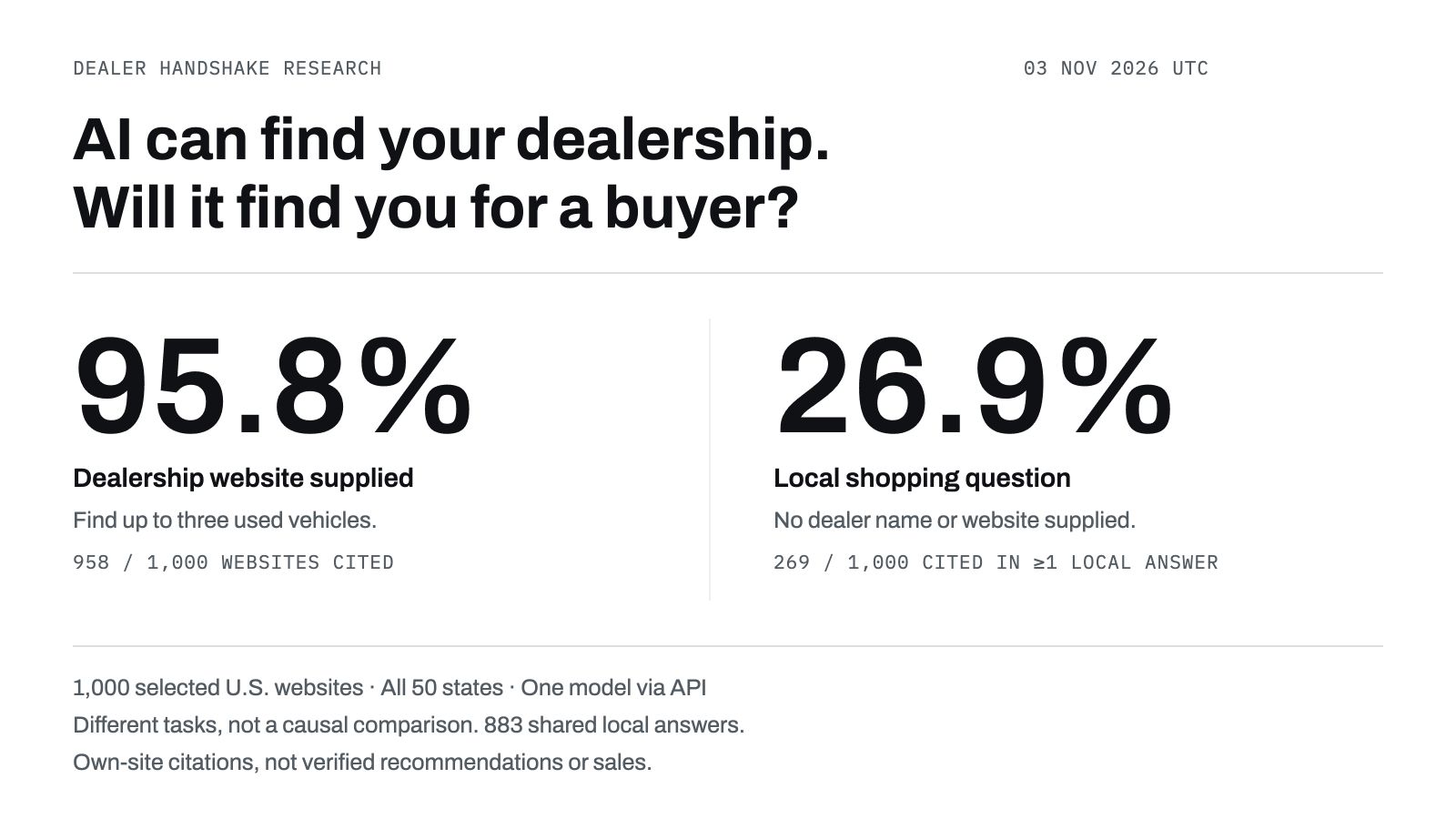
Dealer Handshake tested both situations across 1,000 U.S. dealership websites with reviewed retail locations in all 50 states. In the named inventory task, 95.8% of websites were cited. In the local shopping task, 26.9% were cited in at least one associated answer.
The practical finding: a successful test with your website supplied does not establish that your dealership will be cited when the shopper leaves your name out. Both questions belong in a dealership AI visibility review.
This is original Dealer Handshake research collected on November 3, 2026 UTC. The unit is a website, including some dealer-group sites. These are citation results for a selected cohort, not national estimates or a measurement of sales.
Two shopping questions, two measured outcomes
1. The buyer already knows the dealership
We supplied the dealership’s official website address and asked a single AI model, through its API, to find up to three used passenger vehicles. The prompt explicitly preferred the dealership’s own vehicle pages and requested supported vehicle details and source links.
958 of 1,000 websites were cited: 95.8%. That measures whether the website appeared as a citation in the completed answer. It does not verify that the model retrieved the page live or that a particular car remained available.
2. The buyer is still choosing where to shop
We asked for local dealerships to consider for a used car under US$30,000 near a specified city, state, and reference ZIP. No target dealership name or website was supplied. The answer could suggest up to five dealerships, with reasons and sources.
269 of 1,000 websites were cited in at least one associated local answer: 26.9%. There were 883 shared local answers covering all 1,000 websites. A single market answer could be associated with several sites; multi-market websites could have several opportunities to be cited.
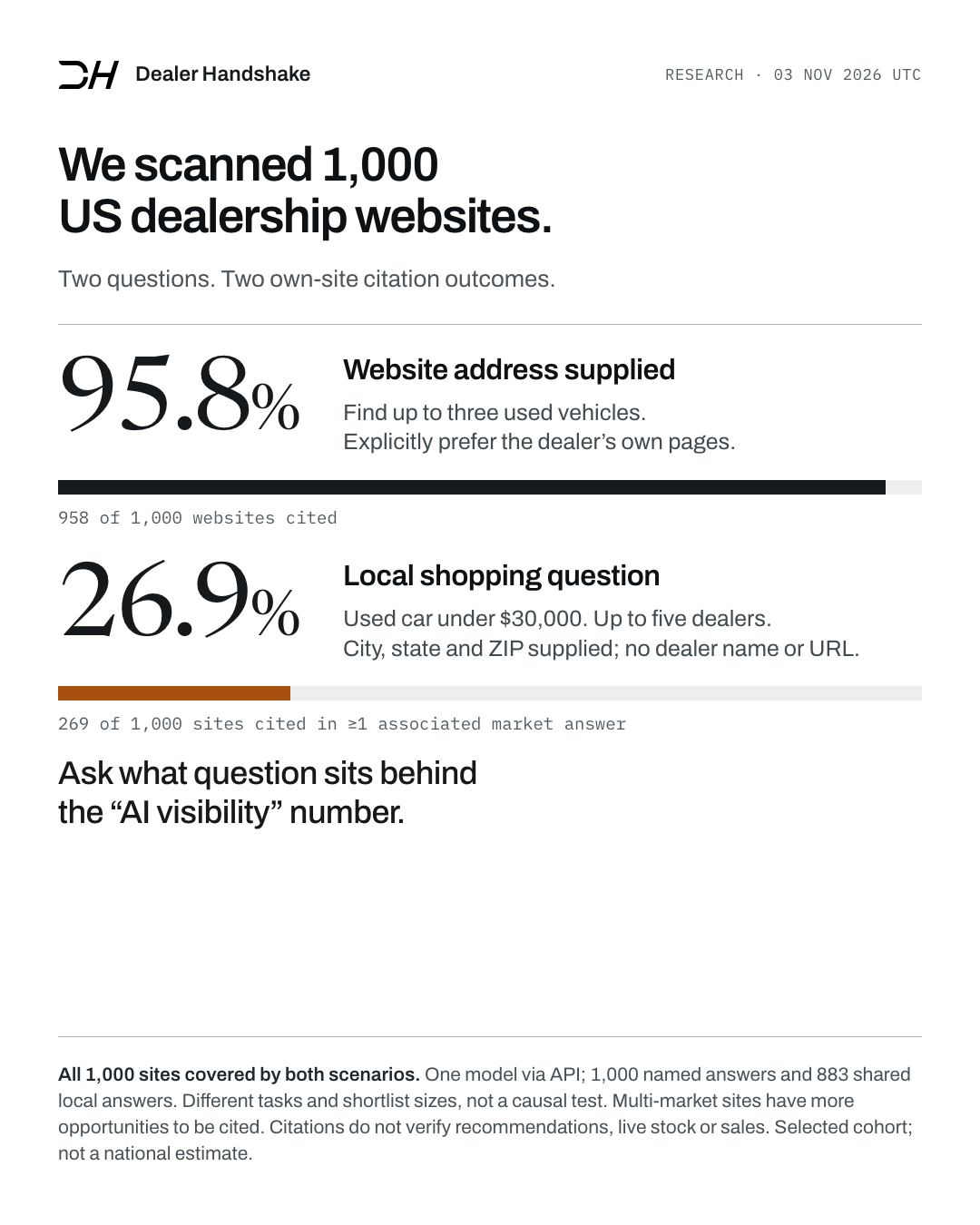
A dealer principal evaluating an “AI visibility” report should ask to see the question behind the number. Supplying the URL and explicitly preferring that site is a different discovery test from asking where to buy a car locally.
A citation is one part of visibility
For this study, a citation means a source link to the target website in the model’s final answer, as recorded in the response annotations. A dealership could also be mentioned through a marketplace, directory, or another source without its own website being cited.
That distinction matters when interpreting a missing citation. The result does not by itself say that the dealership was absent from the answer, that the assistant could not read its website, or that a buyer was lost. It also does not establish that a cited dealership fit the shopper’s location and budget.
The two tasks changed more than the presence of a name: one asked for vehicles from a supplied site; the other asked for local dealerships. We therefore report each task on its own terms. The useful response is to test both parts of the shopping journey and inspect the actual answers.
A crawler refusal did not mean absence from AI answers
We also compared our crawler’s homepage response with the separate named inventory answer. 78 websites returned HTTP 403 or 429 to our crawler. Of those, 77 were still cited in the AI inventory task.
That is 98.7% of this particular subgroup. The retained homepage responses and AI citation annotations were reviewed for all 78 sites. A refusal to one client was not a reliable stand-in for whether the site appeared in the separate AI answer.
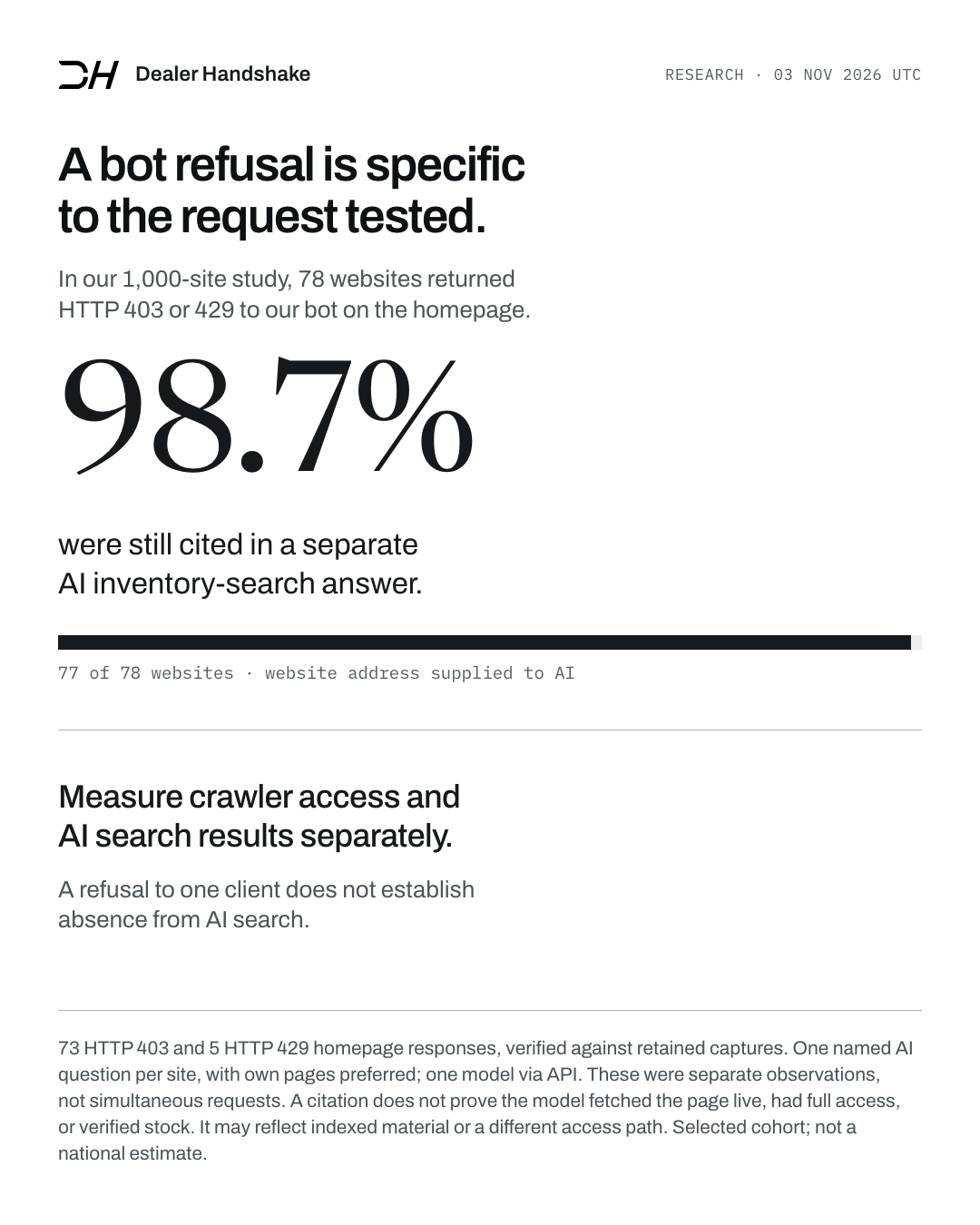
The operational lesson is straightforward: investigate an access problem for the client and request that encountered it, and measure AI answers separately. A scanner result and a search-answer result answer different questions.
What dealers should ask their AI visibility provider
A useful evaluation makes the evidence easy to inspect. Ask for these three demonstrations:
- A named inventory answer. Supply the official website. Inspect the cited vehicle pages and compare the answer with the dealership’s actual records.
- A local shopping answer. Use the market, budget, and vehicle needs of a plausible buyer. Leave the dealership name out. Save the question, date, model, answer, and source links; review mentions as well as own-site citations.
- A connected inventory and inquiry flow. In a supported assistant connection, retrieve a specific current vehicle and demonstrate how a shopper-approved inquiry reaches the sales team. Use an authorized test, not an unsolicited live lead.
These checks turn a broad promise about automotive SEO, GEO, or AI visibility into evidence a dealership can evaluate. Keep website readability, answer inclusion, inventory accuracy, and CRM delivery as separate results.
Website fundamentals still matter. Google Search Central’s guidance says established SEO practices remain relevant to AI Overviews and AI Mode, including accessible text, crawl access, internal links, and structured data that matches the page. Our API study does not measure those Google products.
Where Dealer Handshake fits: the U.S. and Canada
Dealer Handshake connects dealer-authorized inventory to compatible AI assistants and routes shopper-approved inquiries into the existing CRM workflow. It gives a supported shopping experience a structured way to search vehicles and retrieve VIN-level details, prices, and availability supplied by the dealer’s feed.
That connection supports the next step after discovery: an assistant working with actual inventory and a buyer who chooses to contact the store. The dealership keeps its website, DMS, CRM, and responsibility for confirming the vehicle and appointment.
Dealer Handshake supports dealerships in the United States and Canada, currently outside Quebec. U.S. inventory uses USD and miles; Canadian inventory uses CAD and kilometres. The research cohort in this article is U.S.-only. The Canadian service offering is separate from the study’s geographic scope.
Explore Dealer Handshake’s supported AI connections, or request a demonstration with your inventory. For a first look at website readability, run the free Dealer Handshake scan. The scan is a starting diagnostic; testing local answers and the connected inquiry flow adds the evidence a buying decision needs.
Study methodology and downloadable results
Study date: November 3, 2026 UTC. Published: November 5, 2026. Publisher and researcher: Dealer Handshake.
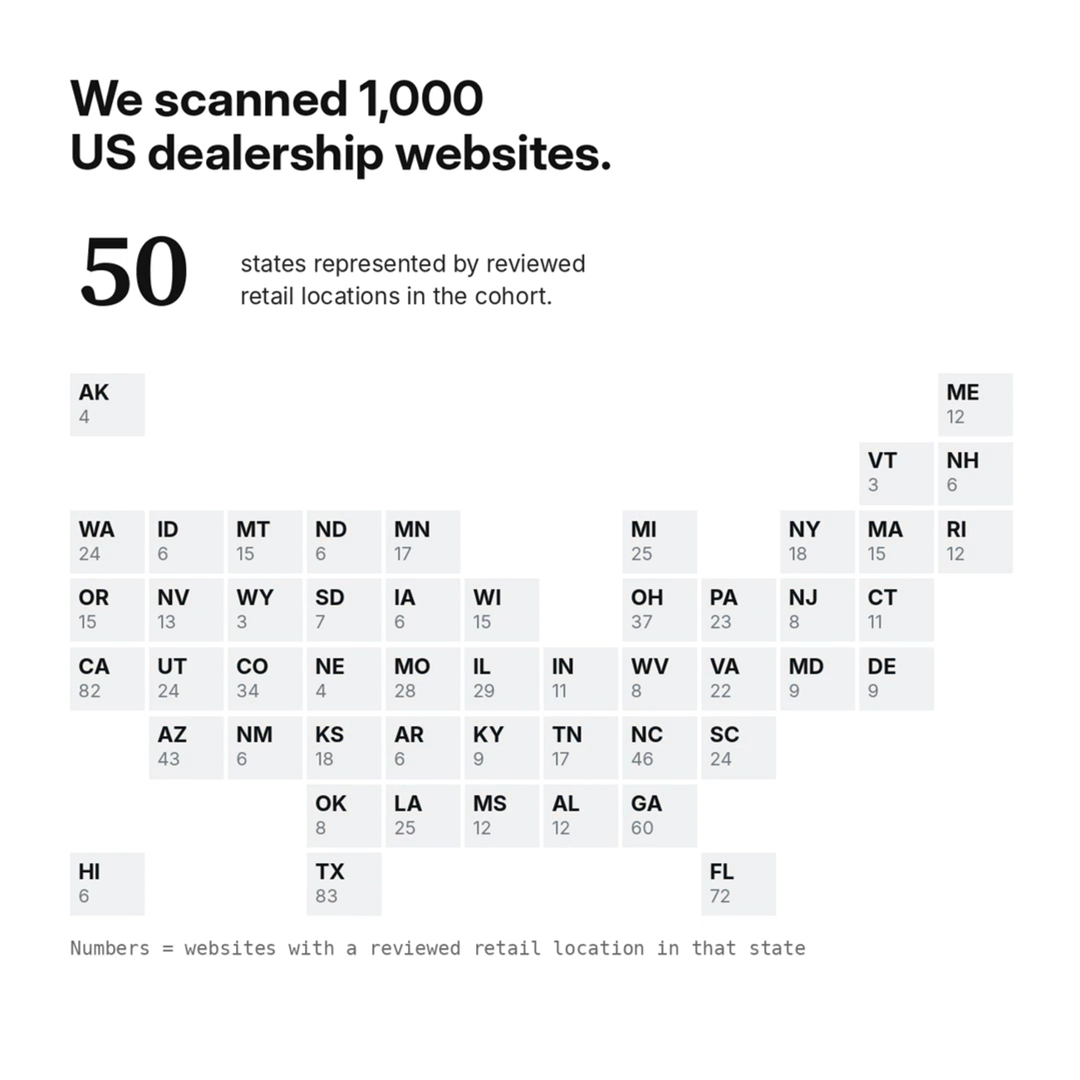
Cohort: 1,000 selected U.S. dealership websites, including group and portal sites, with reviewed retail locations in all 50 states. Selection was designed for a diverse provider cohort, not random national representation or market-share weighting. Sites were not replaced for blocking a crawler, a low score, or an unfavorable AI answer.
AI configuration: one model, gpt-6-luna, via API with
web search, low reasoning effort, a 2,000-token output limit, up to two tool calls,
and low search context. This was not a test of every assistant or of the consumer
ChatGPT interface.
Observations: 1,000 named inventory answers and 883 shared local answers, joined to all 1,000 sites. Local coverage was extended to all confirmed retail geographies while keeping the same prompts, model settings, cohort, and existing completed answers. Multi-market sites had more citation opportunities, so website-level outcomes are correlated.
Outcome: own-site citations in final-answer annotations. For the local task, a website counted if cited in at least one associated answer. Website counts are not counts of independent local answers. A citation does not verify stock, pricing freshness, geographic fit, or recommendation quality.
Not measured: enquiries, form submissions, lead delivery, appointments, or sales impact. The study did not test an improvement caused by installing Dealer Handshake.
Download the aggregate results and exact prompt templates (JSON) or the results table (CSV). The JSON includes the source archive checksum, denominators, definitions, and selection notes. The retained source archive contains the original observations; the public download is an aggregate summary, not the raw archive.
Suggested citation: Dealer Handshake. “AI can find your dealership. Will it find you for a buyer?” Published November 5, 2026; study conducted November 3, 2026 UTC.
For implementation details, see how to make dealership inventory searchable in ChatGPT. For the broader market, see the car-shopping shortlist is moving into AI. This article was prepared with AI assistance and checked against the retained study records.