Can a shopper’s AI agent contact your dealership? We checked 790 websites
We read the HTML that 790 US dealership websites served on November 3, 2026, without running scripts. 476 carried a lead form, 4 of those forms had complete markup, and 184 sites had neither a lead form nor a tap-to-call link. Here are the numbers and the fixes, cheapest first.
What an agent finds on a dealer website
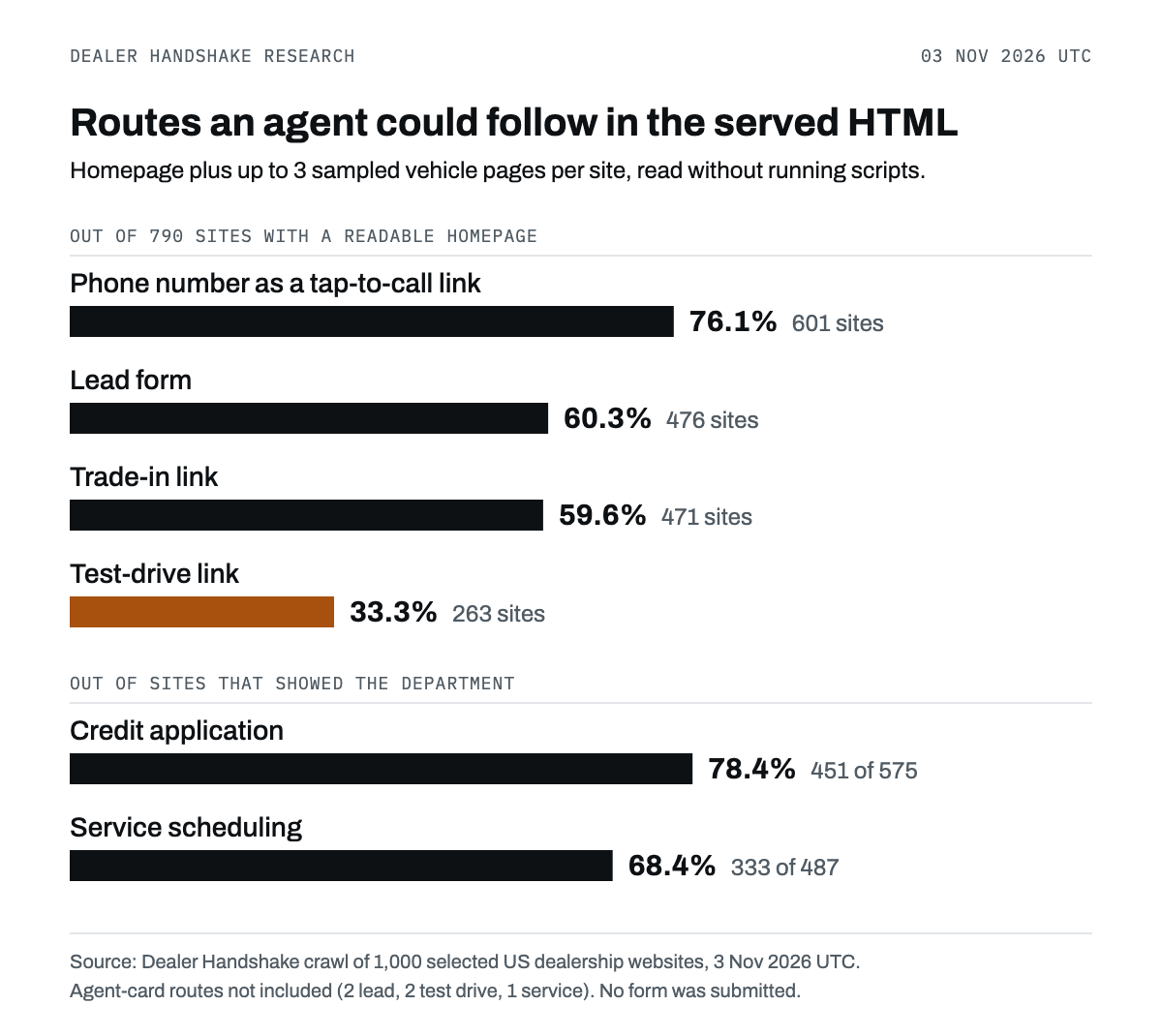
Usually, through the phone number or a lead form. On November 3, 2026 we read the HTML that 790 US dealership websites served, without running any scripts. A shopper’s AI agent would find a phone number it could dial on most of them and a lead form on six in ten. It would rarely find a test-drive link, and the forms gave software little help in filling them in. Of the 790 sites:
- 601 (76.1%) showed the phone number as a tap-to-call
tel:link. - 476 (60.3%) served a lead form, meaning a form with an email or phone field plus a name or message field.
- 263 (33.3%) linked a test-drive request page.
- 4 of the 476 lead forms (0.8%) gave every field a name and a label and tagged a contact field with a standard autocomplete token.
By AI agent we mean an assistant acting for a car shopper, for example one asked to send a dealership a question about a car or to request a test drive. AI tools that a dealership runs for its own sales or BDC team are a separate subject.
We never submitted a form and did not measure lead delivery. These numbers describe what each page offered. They say nothing about how many inquiries a site receives.
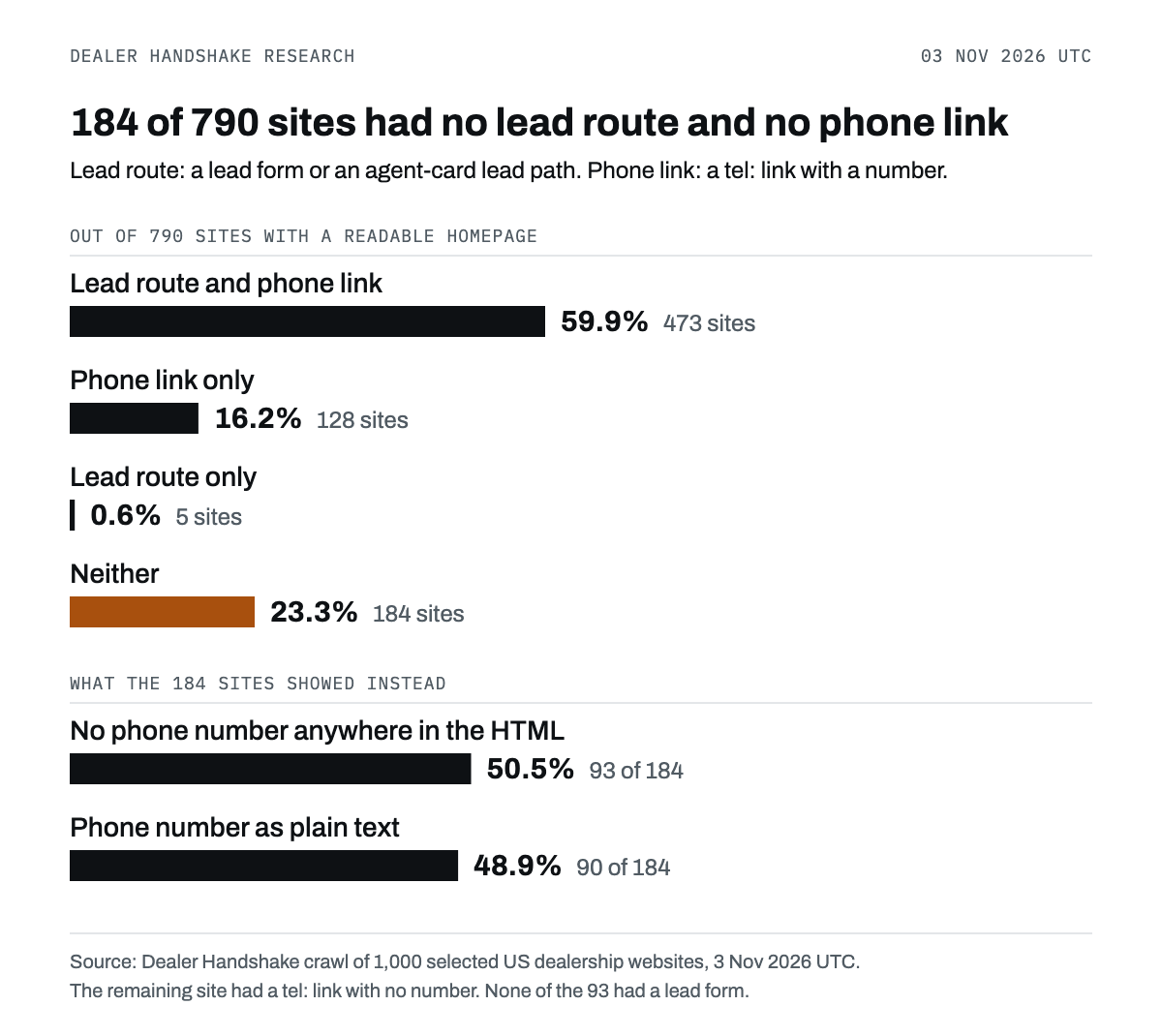
184 sites had no lead form and no phone link
473 of the 790 sites (59.9%) had both a lead route and a tap-to-call link. 128 (16.2%) had only the phone link and 5 (0.6%) had only the lead route. 184 (23.3%) had neither in the pages we read. Two of the lead routes came from agent cards, covered below.
The 184 sites need different fixes. 90 displayed a phone number as plain text without a link. 93 had no phone-shaped text anywhere in the served HTML, and none of those 93 had a lead form. That pattern fits a page that draws its content with scripts after it loads, though we did not confirm the cause site by site. The last site had a tel: link with no number in it.
Lead forms sat on vehicle pages more often than on homepages. 145 of the 790 homepages (18.4%) carried one. On 328 sites the first lead form we found was on a sampled vehicle page, and on 3 it was on another inner page. We did not read contact pages, so some sites may have a working form one click from the homepage.
4 of 476 dealer lead forms had complete markup
Software that fills in a form has to work out which box takes which value. Our check read each field’s name attribute, its label and its autocomplete token. The HTML Living Standard describes the autocomplete attribute as a hint to the browser about what input a field expects, with tokens such as name for a full name, given-name and family-name for first and last name, email for an email address and tel for a full phone number with country code (WHATWG HTML, section 4.10.19.7 Autofill, read November 24, 2026).
We checked the first lead form on each site. It passed when every field had a name attribute and a label, and at least one name, email or phone field carried a standard autocomplete token. Placeholder text inside an empty box did not count as a label. 4 of the 476 forms passed. 465 (97.7%) had no standard autocomplete token on any name, email or phone field. 48 (10.1%) had at least one field without a label. 10 (2.1%) had a field without a name attribute, and the HTML standard leaves such a field out of a normal form submission (section 4.10.22.4, read November 24, 2026). A form can miss more than one item, so these counts overlap.
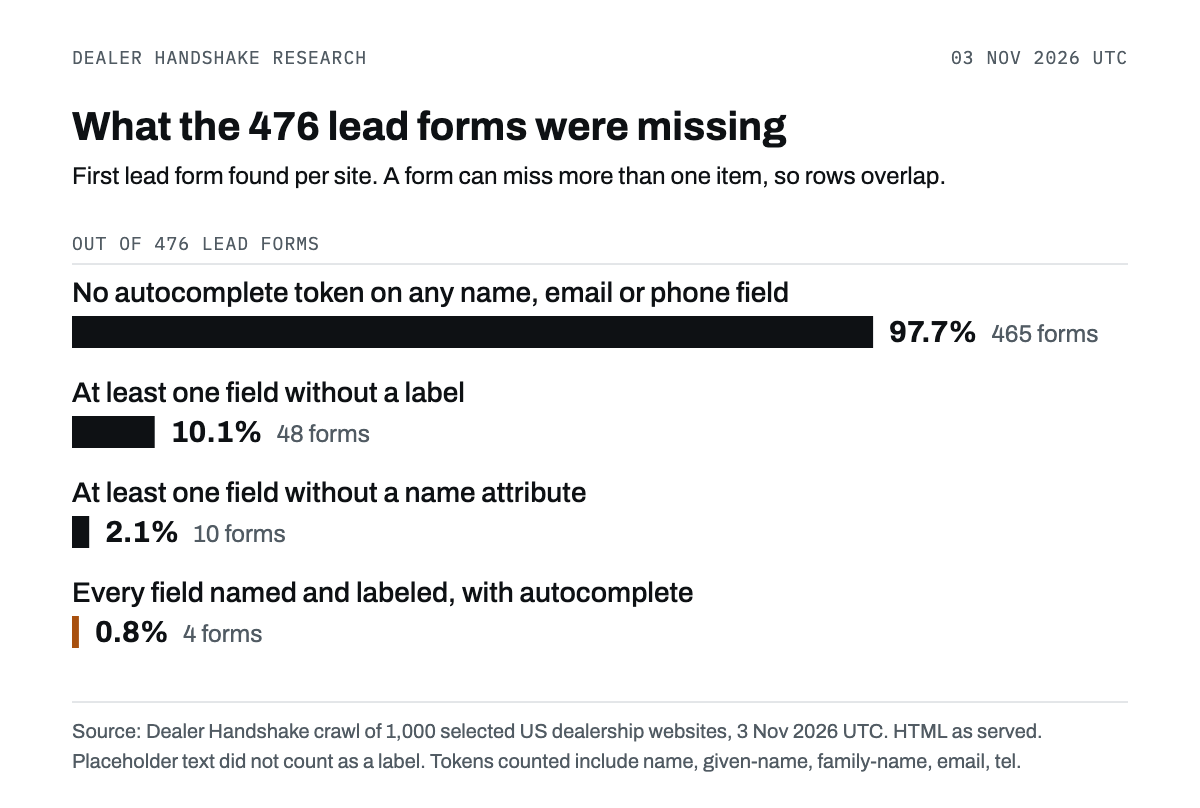
We did not test whether any particular assistant reads these tokens. They are the standard way to state what each field holds. The form below passes all three checks. On a vehicle page, the hidden stock number tells the store which car the question is about. If your form asks for first and last name separately, use given-name and family-name.
<form action="/contact/" method="post">
  <input type="hidden" name="stock_number" value="A1234">

  <label for="lead-name">Full name</label>
  <input id="lead-name" name="name" type="text" autocomplete="name">

  <label for="lead-email">Email</label>
  <input id="lead-email" name="email" type="email" autocomplete="email">

  <label for="lead-phone">Mobile phone</label>
  <input id="lead-phone" name="phone" type="tel" autocomplete="tel">

  <label for="lead-question">Question</label>
  <textarea id="lead-question" name="question"></textarea>

  <button type="submit">Send to the dealership</button>
</form>
Test-drive links were the rarest request path
Beyond a general question, a shopper may ask an agent to book a test drive, get a trade-in value, start a credit application or schedule service. We looked for a link to each request and opened up to two matching links per request type.
| Request | Sites counted | Link found | Opened and answered | Dead link | No link |
|---|---|---|---|---|---|
| Test drive | 790 | 263 (33.3%) | 240 | 26 | 499 |
| Trade-in value | 790 | 471 (59.6%) | 401 | 11 | 308 |
| Credit application | 575 with a finance section | 451 (78.4%) | 407 | 6 | 118 |
| Service scheduling | 487 with a service department | 333 (68.4%) | 273 | 7 | 146 |
“Link found” includes links we did not open. Agent-card routes are left out of the table, 2 for test drives and 1 for service, so those two rows add up to 788 of 790 and 486 of 487.
Test drive trailed every other request. 263 of 790 sites (33.3%) linked a test-drive page, and 499 (63.2%) had no test-drive link we could find. Of those 499, 249 had a general lead form an agent could use instead and 250 had no lead form either. 26 more sites had a test-drive link that failed when opened, and 25 of those 26 returned page not found (HTTP 404).
Credit applications and service scheduling are counted only on sites that linked a finance section or a service department, because a used-car lot may have neither.
Routes built for software were rare
An agent card is a structured alternative to a web form. The A2A protocol specification defines it as “a JSON metadata document published by an A2A Server, describing its identity, capabilities, skills, service endpoint, and authentication requirements” and lists https://{server_domain}/.well-known/agent-card.json as the well-known place to find it (A2A specification 1.0.0, read November 24, 2026).
Our crawler requested that address on 709 sites and got a readable answer from 630. 3 of those 630 served a card. 2 used the Auto Agent Protocol format, an open standard that Dealer Handshake implements, and both point lead requests to Dealer Handshake’s own interface. Those 2 sites account for every agent-card route in this study. Both cards declared test-drive requests and one also declared service requests.
Other machine-readable signals were also uncommon. 62 of 790 sites (7.8%) sent an HTTP Link header advertising a machine-readable resource, and 58 of those 62 pointed to a JSON record of the page in the site’s content management system. When we requested a sampled vehicle page with an Accept: text/markdown header, 4 of the 568 sites that gave a usable answer returned Markdown.
Apart from those 2 agent cards, the routes these sites offered an agent on November 3, 2026 were the forms and phone numbers built for human visitors.
What to fix, cheapest first
- Link every phone number. Wrap each displayed number in a
tel:link with the full number, such as<a href="tel:+13125550142">(312) 555-0142</a>. In the study, 91 of the 790 sites showed their number as text only and 5 had atel:link with no number in it. - Serve the lead form in the page source. 158 of the 790 sites had no form element in the served HTML, and 154 more had only other forms, such as a search or newsletter box. If your inquiry form loads from a script, ask your website provider to include an HTML version in the page source of the homepage, the contact page and each vehicle page.
- Label every field and add autocomplete tokens. Give each field a visible label and use the tokens
name,emailandtel, as in the example above. Ask your provider to change the form template so the fix reaches every vehicle page at once. - Give test drives their own working link. Link each vehicle page to a test-drive request page with a plain address such as
/schedule-test-drive/, and pass the stock number. A button that only opens a script pop-up has no address that a script-free reader can follow. Open the link after every site update: 25 of the 26 broken test-drive links we found returned HTTP 404. - Open your other request links. When we opened them, the trade-in link failed on 11 of 790 sites, the credit-application link on 6 of 575 and the service link on 7 of 487, with an error or a bot challenge.
To check your own site, open your homepage and one vehicle page in a desktop browser and choose View Page Source, which shows the HTML as served. The Inspect panel shows the page after scripts ran, so it can show a form that a script-free reader never receives. Search the source for <form, autocomplete=, href="tel: and test-drive. The free Dealer Handshake scan also reads a site without running its scripts and shows the evidence for each check.
Where Dealer Handshake fits
The fixes above help any agent that reads your pages. A direct connection is the structured route. Dealer Handshake connects dealer-authorized inventory to compatible AI assistants and routes shopper-approved inquiries into the dealership’s existing CRM workflow. It supports dealerships in the United States and Canada, currently outside Quebec. Each assistant decides whether to use a connection, and this study did not measure inquiries sent through one.
For the inventory side of the same question, see what an AI assistant sees of a dealer’s inventory and our guide to making dealer inventory searchable in ChatGPT.
Methods and limits
The cohort is 1,000 selected US dealership websites, chosen to cover a wide range of website providers. It is a convenience cohort, not a random sample, and it is not weighted by market share. We collected the data in one pass on November 3, 2026 UTC.
866 of the 1,000 sites answered our crawler, and 790 returned a homepage we could read. For 96 of those 790, the crawler’s own request did not return a usable page and the checks used a second request sent with a regular browser user agent.
For each site we read the homepage and up to three sampled vehicle pages, as served, with no scripts run. A tool that runs scripts or drives a full browser may find forms and links that we did not count. Search, newsletter and sign-in forms did not count as lead forms. Markup was checked on the first lead form found, homepage first, then vehicle pages.
Request links were matched by words in the link address, such as test-drive, trade-in, credit-application and schedule-service, and by links to outside service schedulers. A link that returned an error or a bot challenge counted as dead. A matching link we did not open still counted as found: 23 test-drive, 70 trade-in, 44 credit-application and 60 service links. The agent-card address was requested on 709 of the 866 sites that answered, and 79 of those requests returned a refusal or error.
We did not measure form submissions, lead delivery, response times, appointments or sales, and we tested no AI assistant against these pages. The same study asked an OpenAI model, gpt-6-luna through the API with web search, about each site. Those citation results are reported in the 1,000-site study and are not used here. Its downloadable CSV and JSON files do not include the checks in this article.
Prepared with AI assistance and checked against the study’s retained records. Published November 24, 2026 from a crawl collected November 3, 2026 UTC. External sources read November 24, 2026: the WHATWG HTML Living Standard, sections 4.10.19.7 and 4.10.22.4, and the A2A protocol specification 1.0.0. Dealer Handshake sells the AI inventory connection described above. This article reports no customer outcome.