When shoppers ask ChatGPT’s model where to buy, it cites dealer inventory pages
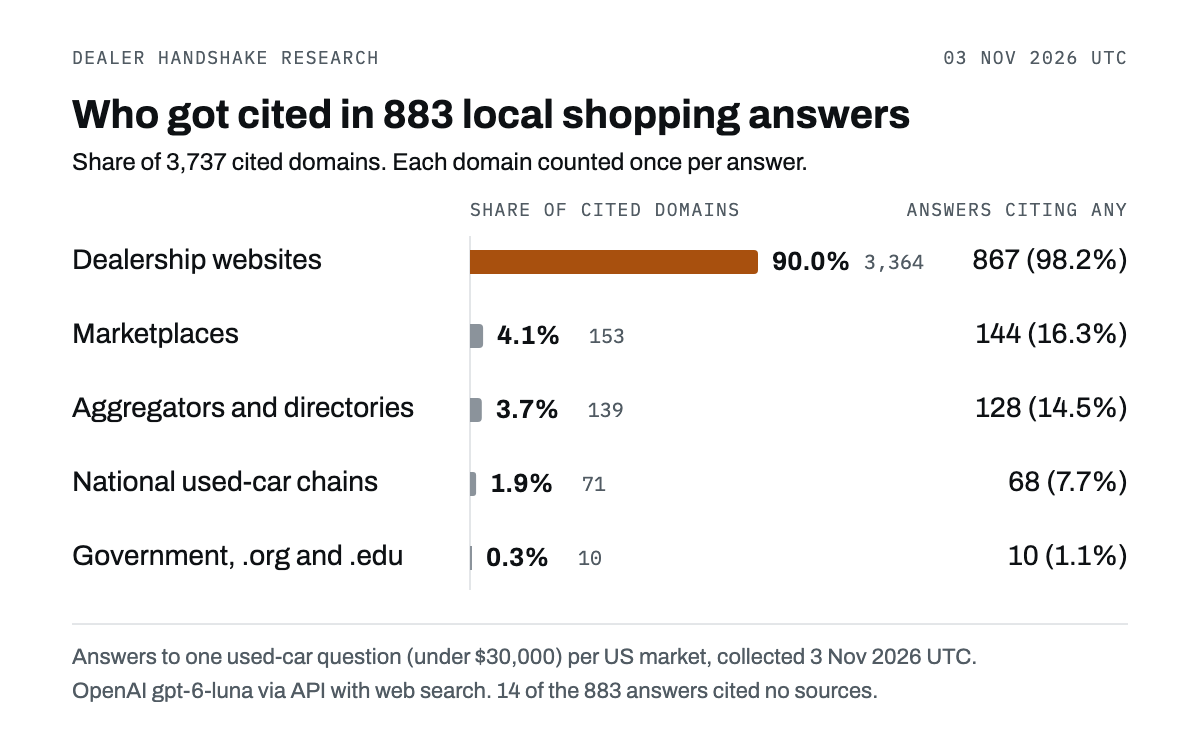
We asked OpenAI’s model with web search where to buy a used car under $30,000 in 883 US markets. Dealership websites were 3,364 of the 3,737 sources it cited, and 67.3% of the dealership pages it cited were used-inventory or search pages.
What the model cited for local shoppers
When a shopper asks ChatGPT’s model where to buy a used car nearby, it cites dealership websites. On November 3, 2026 UTC we asked OpenAI’s model one question for each of 883 US markets: which local dealerships to consider for a used car under $30,000. The 883 answers cited 3,737 domains, with each domain counted once per answer. Dealership websites accounted for 3,364 of them (90.0%).
These answers come from OpenAI’s model called through the API with web search turned on. The consumer ChatGPT app was not part of the test and may search and answer differently.
867 of the 883 answers (98.2%) cited at least one dealership website. The median answer cited four (mean 3.81), and 804 answers (91.1%) cited three or more. The prompt asked for up to five dealerships, so the answer format favored naming stores.
Third-party sites appeared in a minority of answers: at least one was cited in 304 of the 883 answers (34.4%). Marketplaces such as Cars.com, Carfax, Autotrader, CarGurus, KBB and TrueCar made up 153 of the 3,737 cited domains (4.1%) and appeared in 144 answers (16.3%). Cars.com alone appeared in 110 answers (12.5%). Aggregator, review and directory sites made up 139 (3.7%), led by the car-buying advice site CarEdge in 82 answers (9.3%). National used-car chains made up 71 (1.9%), with CarMax in 43 answers (4.9%). Government, .org and .edu sites made up 10 (0.3%).
Across all markets the answers cited 2,771 different dealership domains, most of them outside the 1,000 websites in our study cohort. Our earlier report on the same study looks at those 1,000 cohort websites: 269 of them (26.9%) were cited in at least one local answer.
How ChatGPT’s model looked for dealerships
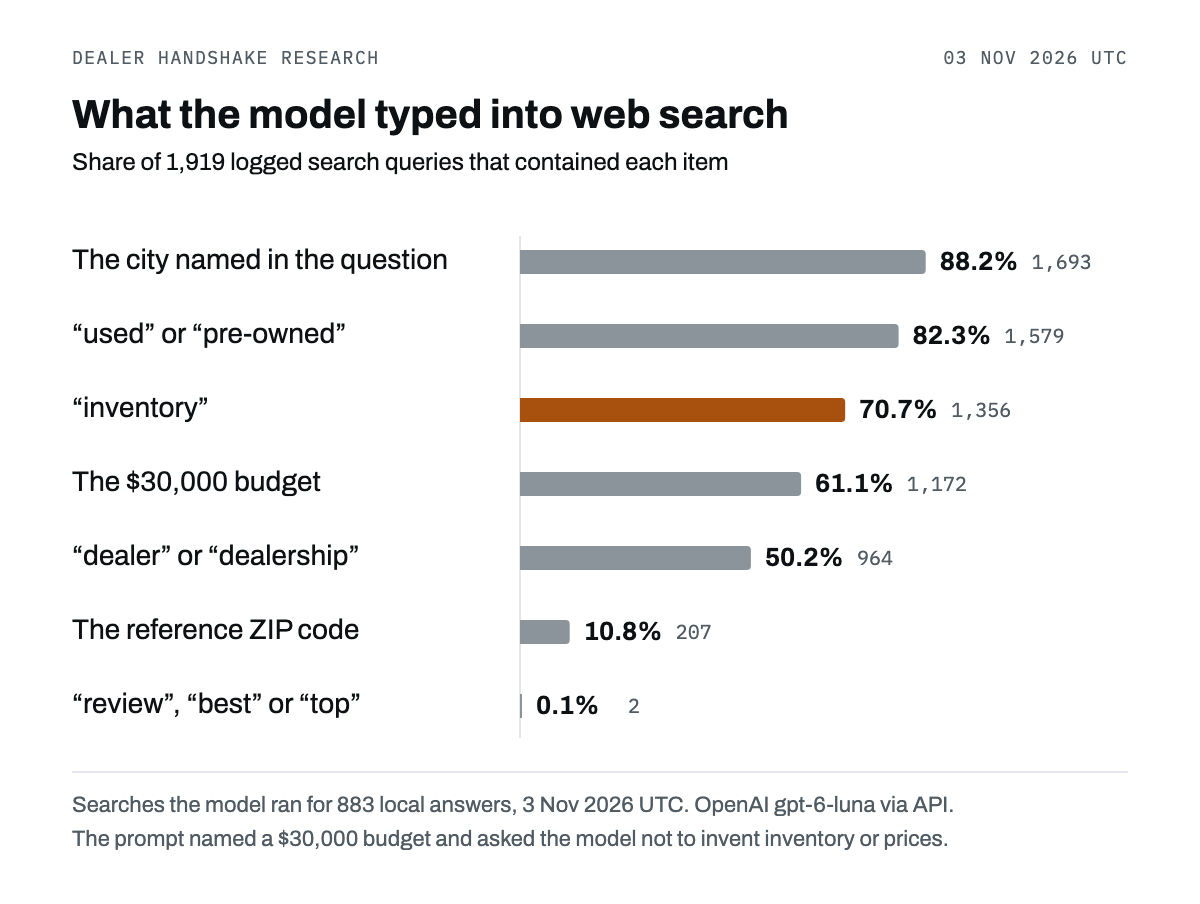
The model’s searches read like a shopper’s inventory search. Its logs for the 883 answers recorded 1,919 web searches with a query string. Of those, 1,693 (88.2%) named the city from the question, 1,579 (82.3%) said “used” or “pre-owned”, 1,356 (70.7%) contained “inventory” and 1,172 (61.1%) included the $30,000 budget. The most common query, used in 169 of the 1,919 searches with only the place changed, was “used cars under $30,000 {city} {state} dealership inventory”.
Searches about reputation were almost absent. Two of the 1,919 queries contained “best” or “top”, and none contained “review”. The prompt named a budget and told the model not to invent inventory or prices, and the searches match that wording. A question about the best-rated dealer could produce different searches. We did not test one.
The search results set the pool the model cited from. The logged sources listed a median of 20 distinct domains per answer, and each of the 3,737 cited domains appeared in the sources logged for its own answer. A useful first test is whether a web search like the one above, with your own city and state, returns your used-inventory page. Our logs do not show which search index the tool used, so a result in a regular search engine is a rough check only.
The used-inventory page was cited most
When the model cited a dealership, it usually linked the used-inventory or search results page. Counting page types per dealership in each answer gives 3,372 page types from the 3,364 dealership citations, because a few stores were cited with two kinds of page. Of the 3,372, 2,268 (67.3%) were inventory or search pages and 926 (27.5%) were homepages. About, contact and directions pages made up 58 (1.7%), individual vehicle pages 39 (1.2%) and other pages 81 (2.4%).
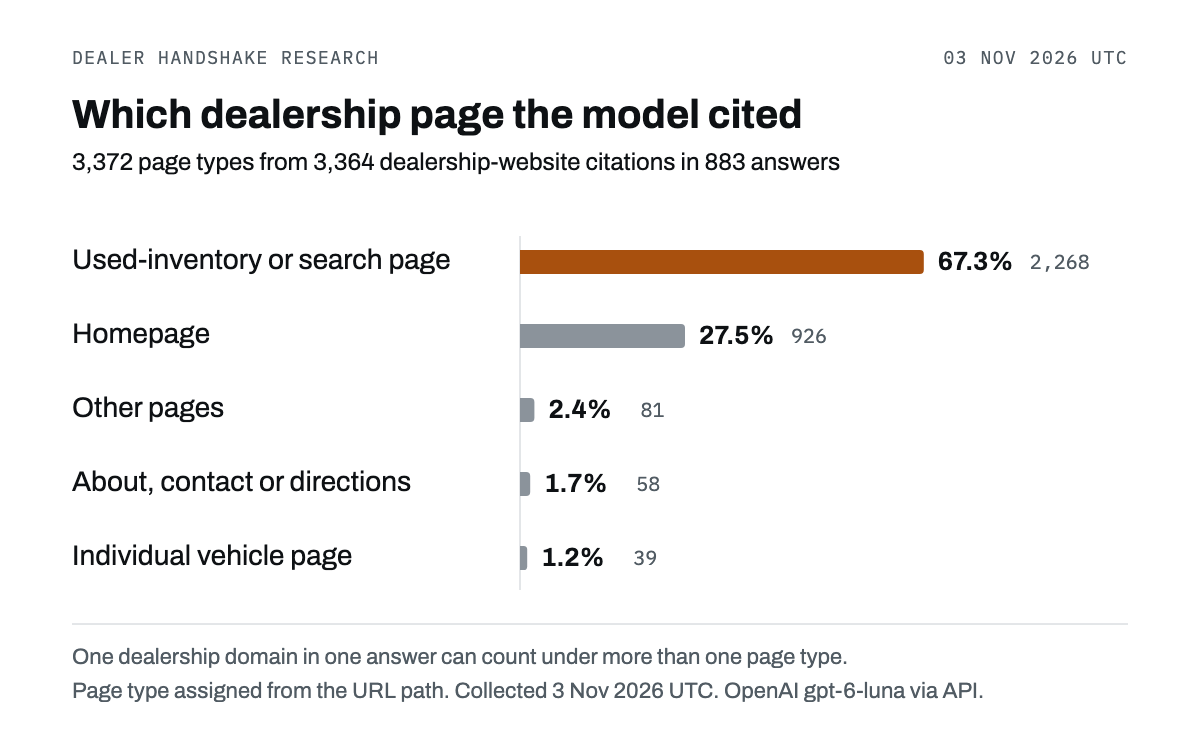
The question asked for stores, and single-car pages were rarely cited. For this kind of question, the used-inventory page is the page to check first and the homepage second.
Some cited pages already matched the question in their address. Of 2,289 cited dealership inventory and search URLs, 279 (12.2%) carried a price filter, either as a parameter such as a maximum price of 30000 or in the path, as in a page for used cars under 30k. The city from the question appeared in 236 of the 2,289 URLs (10.3%), and 143 had both, in paths shaped like /used-cars-under-30k-{city}-{state}. We did not test whether adding such pages changes what the model cites.
Six checks for your dealership’s AI visibility
These checks follow from what the model searched for and which pages it cited. They cover the website side of GEO, generative engine optimization, for a car dealership. None of them guarantees that a model will cite your store.
| Check | How to run it | What this study found |
|---|---|---|
| Vehicles in the used-inventory page HTML | Open your used-inventory page, choose View Page Source and search for the model name of a car you have in stock. | 2,268 of 3,372 cited dealership page types (67.3%) were inventory or search pages. |
| City and state on that page | Confirm that the page title, main heading and visible text name your city and state. | 1,693 of 1,919 searches (88.2%) named the city from the question. We did not measure page titles. |
| Price filters in the URL | Set a maximum price in your used search, copy the address into a private window and confirm that the same filtered list loads. | 279 of 2,289 cited dealership inventory URLs (12.2%) carried a price filter. |
| Location and hours on the homepage | Check that the street address, city, state, phone and sales hours appear as text on the homepage, outside images and map widgets. | Homepages were 926 of 3,372 cited page types (27.5%). The prompt asked the model to state each store’s city and state. |
| OAI-SearchBot allowed in robots.txt | Open /robots.txt on your domain and look for a Disallow rule that names OAI-SearchBot or applies to all user agents. | This study did not compare robots rules with citations. OpenAI’s statement is quoted below. |
| Visits from cited links | Filter your analytics by the traffic source “openai”. | 3,400 of 3,795 cited URLs (89.6%) in these API answers carried utm_source=openai. We did not check how the ChatGPT app tags links. |
If vehicles load only after scripts run, a reader that takes the raw HTML sees an empty list. Our article on what an AI assistant actually sees on a dealer’s website covers how much of a dealer’s inventory automated readers reach.
OpenAI’s crawler documentation, read November 24, 2026, says: “Sites that are opted out of OAI-SearchBot will not be shown in ChatGPT search answers.” The same page says such sites can still appear as navigational links, and that OpenAI’s systems can take about 24 hours to adjust after a robots.txt update (OpenAI crawler documentation). Our companion article on dealer robots.txt rules for AI crawlers has more on the file.
Ask the question for your own ZIP
Run the study’s question yourself with your city, state and ZIP. The full prompt is in the methods section below. Save the date, the complete answer and every source link. Then record whether your store is named, which of your pages is linked and which other stores and sites appear.
Ask again on a few different days before you draw conclusions. A model can answer the same words differently, and our study observed each market once. If you test in the ChatGPT app, write that down too, because our results come from the API model.
Dealer Handshake offers a free website scan that shows what AI can read on your website. Dealer Handshake connects dealer-authorized inventory to compatible AI assistants and routes shopper-approved inquiries into your existing CRM workflow. It supports dealerships in the United States and Canada, currently outside Quebec.
What this study does not show
- One model, one prompt and one day. Every answer came from the same OpenAI API model on November 3, 2026 UTC, with low search context and at most two tool calls. Other assistants, the ChatGPT app and other questions were not tested.
- A citation is a source link. It does not show that the model recommended the store, that a car was in stock or under $30,000, or that any shopper visited or bought.
- We did not check whether each suggested store was near the market named in the question.
- The 883 markets come from the 1,000 dealership websites in our cohort, a selected set of US cities in all 50 states. They are not a national sample.
- This article compares no website features with citation rates. The patterns above describe what was cited and do not explain why.
- Page types come from URL paths. A few vehicle pages with unusual URLs may be counted as other pages.
Methods and data
Study date: November 3, 2026 UTC. Published: November 24, 2026. Researcher: Dealer Handshake.
The question. Each market received this prompt, with its city, state and reference ZIP filled in:
“I am shopping for a used car under $30,000 near {City}, {State}, United States (reference ZIP {ZIP}). Which local car dealerships should I consider? Search the web and suggest up to five dealerships with a short reason and source links. For each dealership, state its physical city and state. Use the specified city AND state; do not substitute a city with the same name in another state. If location or budget evidence is uncertain, say so. Prefer current, relevant evidence. Do not invent inventory or prices. Keep your answer under 450 words.”
Markets. We used every source-confirmed retail city, state and ZIP among the 1,000 websites in our cohort. The cohort is a diverse-provider convenience sample of US dealership websites. It was not drawn at random or weighted by market share. That gave 883 markets in 734 city and state pairs across all 50 states. Each market received one answer, shared by every cohort website in that market, and all 883 requests completed.
Model. gpt-6-luna through OpenAI’s API with the web search tool, low reasoning effort, low search context, at most two tool calls and a 2,000-token output limit.
Citations. A citation is a url_citation annotation in the final answer. We grouped citations by registrable domain and counted each domain once per answer, which gave 3,737 cited domains. Fourteen answers had no citations. The tracking-tag check counted all 3,795 cited URLs. The price and city checks counted the 2,289 cited URLs on dealership websites classified as inventory or search pages.
Classification. Domains were grouped by reviewed lists of marketplaces, national used-car retail chains, aggregators and directories, and government, education and non-profit sites. Every other cited domain was treated as a dealership website. A random sample of 45 domains from that group was reviewed by hand, and all 45 were dealership websites. Page types were assigned from the URL path.
Searches. We read the query of every search action in the answers’ web search logs, 1,919 in total. 285 of the 883 answers logged three searches with a query under the two-call setting. A city match required the whole city name. A budget match counted “30,000”, “30000” or “30k”. “Dealer” also matched “dealers” and “dealership”. OpenAI’s web search documentation, read November 24, 2026, describes the sources field as the complete list of URLs the model consulted and notes that sources often outnumber citations.
Data. The study’s aggregate results and exact prompt templates are available as JSON and CSV. The source, page and search breakdowns in this article were computed from the retained answer records and are not in those files.
Suggested citation: Dealer Handshake. “When shoppers ask ChatGPT’s model where to buy, it cites dealer inventory pages.” Published November 24, 2026. Study collected November 3, 2026 UTC.
Prepared with AI assistance and checked against the retained study records. Published November 24, 2026 from Dealer Handshake’s study collected on November 3, 2026 UTC. OpenAI documentation quoted as read on November 24, 2026. Dealer Handshake sells the inventory connection described above. This article reports no customer outcome.