Should car dealers block GPTBot? What 763 dealership robots.txt files show
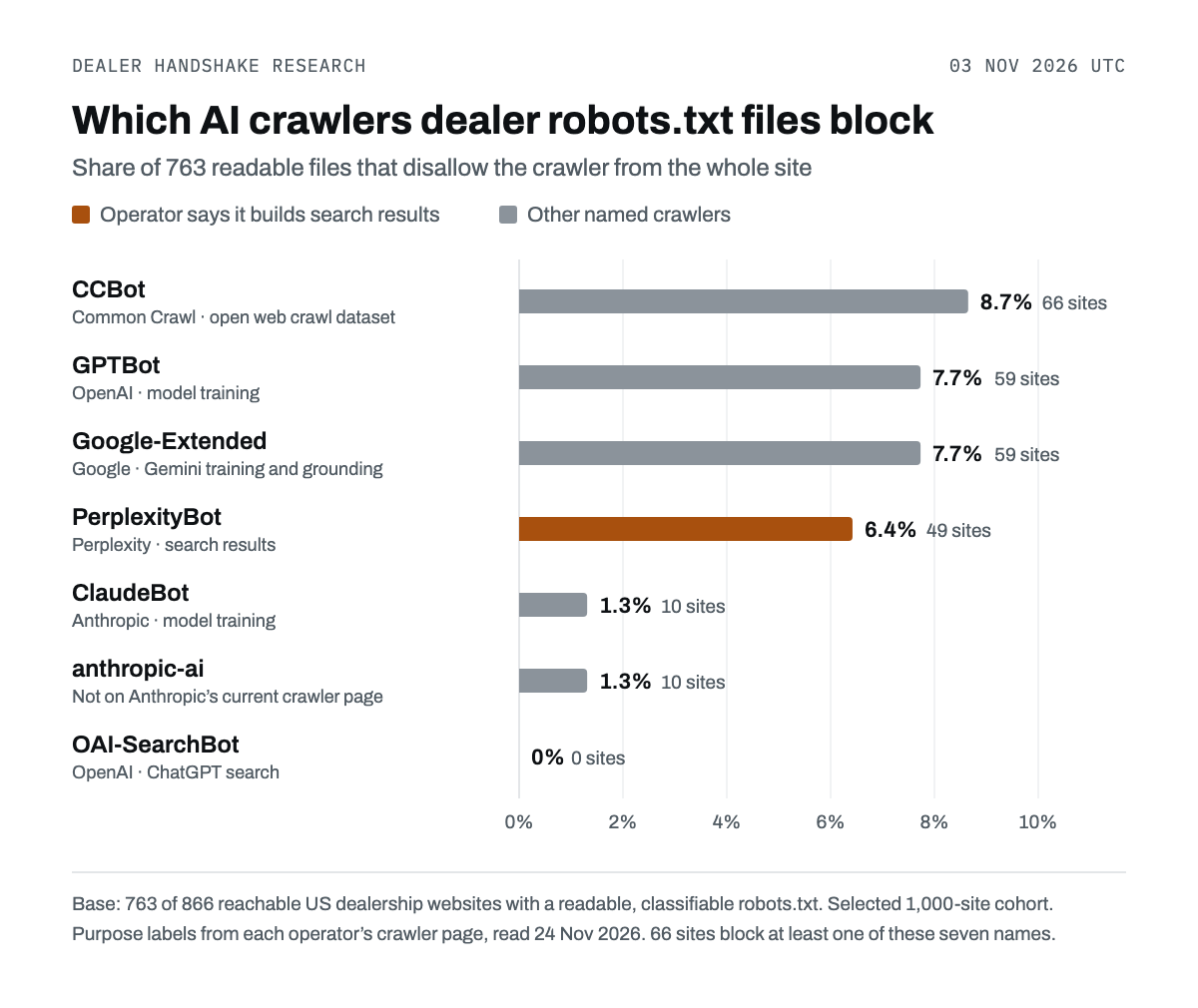
We checked robots.txt on 866 reachable US dealership websites on November 3, 2026. Of the 763 files we could classify, 59 block OpenAI’s training crawler and none block its search crawler. Every GPTBot block repeats one of two identical patterns.
What dealer robots.txt files tell AI crawlers
Blocking GPTBot is a decision about model training. OpenAI runs a separate crawler, OAI-SearchBot, for ChatGPT search, and its crawler documentation says each setting is independent of the others. A dealership can answer the training question and the search question separately. In our data, every file that blocks GPTBot follows one of two repeated patterns, so the first thing to find out is whether anyone at the store made the choice.
On November 3, 2026 UTC our crawler requested robots.txt from 1,000 selected US dealership websites. 866 were reachable, and 763 had a robots.txt we could classify for AI crawler rules. Of those 763 sites:
- 59 (7.7%) disallowed GPTBot from the entire site.
- 0 disallowed OAI-SearchBot. All 59 sites that blocked GPTBot left OAI-SearchBot allowed on their inventory pages.
- 66 (8.7%) disallowed at least one of the seven AI crawler names we checked, and all 66 disallowed CCBot.
- 697 (91.3%) disallowed none of the seven.
OAI-SearchBot vs GPTBot and the other AI crawlers
Each AI company documents its own crawlers. Their stated purposes fall into three groups. Training crawlers collect pages that may be used to train models. Search crawlers build the index behind the company’s search answers. User-triggered fetchers open a page because a person asked a question. The table uses each operator’s own description.
| Crawler | Operator | What the operator says it does | What a block affects, per the operator | Sites blocking it |
|---|---|---|---|---|
| GPTBot | OpenAI | Crawls content that may be used to train its generative AI foundation models. | Indicates the site’s content should not be used for that training. | 59 (7.7%) |
| OAI-SearchBot | OpenAI | Surfaces websites in ChatGPT’s search features. | Opted-out sites are not shown in ChatGPT search answers. They can still appear as navigational links. | 0 (0%) |
| ChatGPT-User | OpenAI | May visit a page when someone asks ChatGPT or a custom GPT a question. Not used for automatic crawling. | OpenAI says robots.txt rules may not apply because a user started the action. It points to OAI-SearchBot for search opt-outs. | Not measured |
| Google-Extended | A robots.txt token with no separate user agent. It controls whether content Google crawls may be used to train future Gemini models and for grounding in Gemini Apps and Vertex AI. | Google says it does not affect inclusion in Google Search and is not a ranking signal there. | 59 (7.7%) | |
| PerplexityBot | Perplexity | Surfaces and links websites in Perplexity search results. Not used to crawl content for AI foundation models. | Perplexity recommends allowing it for a site to appear in its search results. | 49 (6.4%) |
| Perplexity-User | Perplexity | May visit a page when someone asks Perplexity a question. | Perplexity says it generally ignores robots.txt because a user requested the fetch. | Not measured |
| ClaudeBot | Anthropic | Collects web content that could contribute to model training. | Signals that the site’s future materials should be excluded from Anthropic’s training datasets. | 10 (1.3%) |
| Claude-SearchBot | Anthropic | Analyzes content to improve the relevance and accuracy of search responses. | Prevents indexing, which may reduce visibility and accuracy in user search results. | Not measured |
| Claude-User | Anthropic | May access a page when someone asks Claude a question. | Prevents retrieval for a user’s query, which may reduce visibility in user-directed web search. | Not measured |
| anthropic-ai | None documented | Anthropic’s crawler page lists the three names above and does not mention this one. | Not documented. | 10 (1.3%) |
| CCBot | Common Crawl, a non-profit | Crawls the web for an open repository of crawl data that anyone can access and analyze. | Stops Common Crawl from crawling the site. The page does not list who uses the data. | 66 (8.7%) |
Sources, each read November 24, 2026:
- OpenAI, Overview of OpenAI Crawlers
- Google Search Central, List of Google’s common crawlers
- Perplexity, Perplexity Crawlers
- Anthropic, Does Anthropic crawl data from the web, and how can site owners block the crawler?
- Common Crawl, CCBot
Google-Extended covers two uses. Google says the token does not affect inclusion in Google Search. It also governs grounding in Gemini Apps, which Google describes as providing content from the Google Search index to the model at prompt time. A Google-Extended block set for training reasons applies to grounding as well.
PerplexityBot is a search crawler by Perplexity’s own description. Of the two search crawlers we checked, it is the only one any site disallowed, on 49 sites.
User-triggered fetchers follow different rules. OpenAI says robots.txt may not apply to ChatGPT-User, and Perplexity says Perplexity-User generally ignores it. Anthropic says its bots honor robots.txt directives. For ChatGPT-User and Perplexity-User, your firewall settings decide access more than your robots.txt does.
Every GPTBot block came from two repeated patterns
The 66 sites that disallow at least one of the seven names fall into three repeated patterns plus one unique file:
- 49 sites carry the same group of 39 user agents with Disallow: /. It names GPTBot, Google-Extended, PerplexityBot and CCBot. It names no Anthropic crawler, and it does not name OAI-SearchBot or ChatGPT-User.
- 10 sites carry another identical pattern, with the same rules on the same line numbers. It disallows GPTBot, Google-Extended, ClaudeBot, anthropic-ai and CCBot, and leaves PerplexityBot allowed.
- 7 sites disallow only CCBot. 6 of them have the same rules on the same lines.
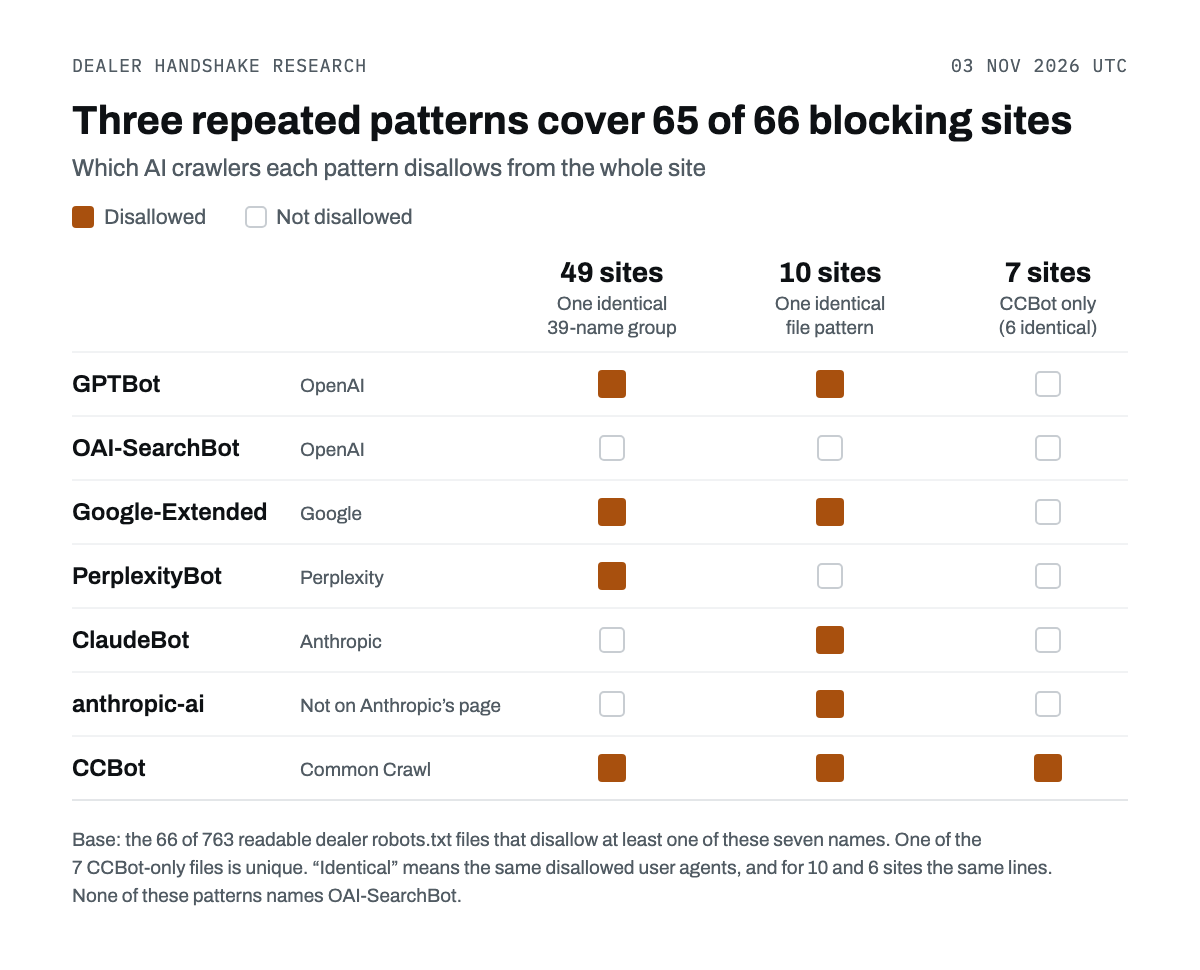
Identical rules on 49 sites and on 10 sites point to shared templates. We did not ask any site who wrote its file or why.
The pattern a site inherits sets its AI policy crawler by crawler. A site with the 39-name group disallows the crawler Perplexity uses for its search results, and that group names no Anthropic crawler. A site with the 10-site pattern disallows Anthropic’s training crawler and leaves PerplexityBot allowed. Neither pattern names OAI-SearchBot. If your file matches one of them, ask who chose it.
Firewalls treated a browser and a named crawler differently
robots.txt states a preference. A firewall or bot-protection service enforces access. On the same day, from the same cloud network, we sent two requests to each reachable homepage. One presented a normal desktop browser user agent. The other came from our crawler, DealerHandshakeBot, which names itself in its user agent and signs its requests.
- The browser-looking request was challenged or refused on 293 of 866 homepages (33.8%).
- Our named crawler met a web application firewall challenge on 70 of 774 sites with a usable response (9.0%). The challenge pages came from Akamai on 49 sites, Cloudflare on 18 and DataDome on 3.
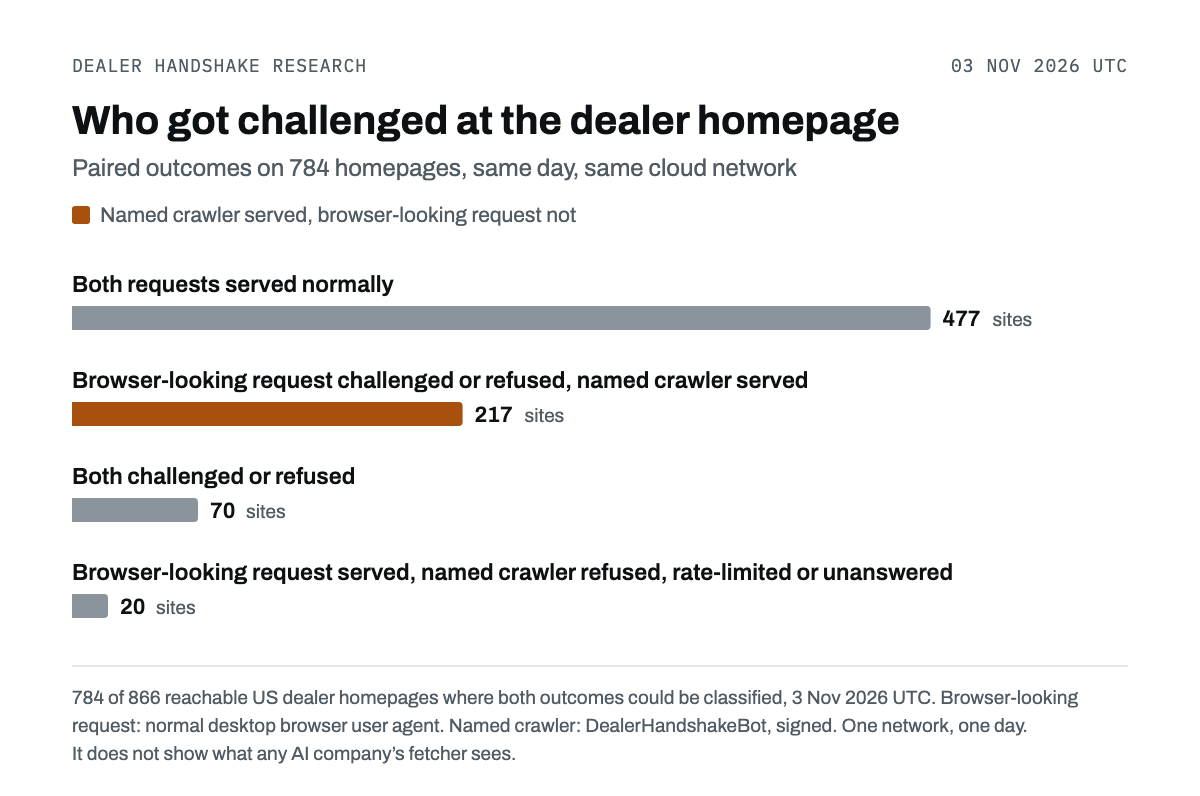
Paired site by site, 217 sites turned away only the browser-looking request, and 20 turned away only the named crawler. All 70 sites that challenged our crawler also challenged or refused the browser-looking request.
This updates our August 2026 sample of 234 sites, published in what an AI assistant actually sees on a dealer’s website. In that run the browser control and our named bot each reached 138 of 234 sites, and we concluded that the network decided refusals. The November run covered 1,000 sites on different infrastructure, and the named crawler got through more often than the browser-looking request. We did not test why. Neither run shows what OpenAI’s, Perplexity’s or Anthropic’s fetchers receive from their own networks. Your firewall logs show that.
Bot protection can also hide the rules themselves. On 70 of the 866 reachable sites, robots.txt returned HTTP 403 to our crawler, so we could not read it. 67 of those 70 were among the sites where our crawler met a firewall challenge at the homepage. Anthropic’s crawler page makes the related point that blocking its IP addresses impedes its ability to read robots.txt, so an IP block may not work as an opt-out.
How to set your dealership’s AI crawler policy
We do not recommend blocking or allowing these crawlers as a group. Decide per crawler whether you want your pages used to train each company’s models, and whether you want each company’s search and answer products to read your pages. Make these checks first:
- Open yourdomain.com/robots.txt in a browser. Under each User-agent line, look for Disallow: /. List every crawler from the table above that is disallowed and every one the file does not name.
- Sort the list by purpose. Training: GPTBot, ClaudeBot and Google-Extended, which also covers Gemini grounding. Search: OAI-SearchBot, PerplexityBot and Claude-SearchBot. User-triggered: ChatGPT-User, Perplexity-User and Claude-User. A disallowed search crawler deserves a second look, because its operator ties it to appearing in search results.
- Ask your website provider in writing whether the AI section came from a template, when it last changed and whether a platform update would overwrite a change you request.
- Search your firewall or bot-protection logs for OAI-SearchBot, ChatGPT-User, PerplexityBot, Perplexity-User, Claude-SearchBot and Claude-User. For each one, note what it received: a normal page, a challenge, HTTP 403 or HTTP 429. OpenAI and Perplexity publish IP address lists for their crawlers, and Common Crawl publishes ranges for CCBot. Common Crawl also warns that some crawlers falsely identify themselves as CCBot, so an allow rule should check the address as well as the name.
- Confirm that robots.txt itself returns HTTP 200 to crawlers.
- After a change, retest the next day. OpenAI says search results can take about 24 hours to adjust after a robots.txt update. Perplexity says changes may take up to 24 hours.
- Write the decision down with the date and the person who owns it, so the next template update can be checked against it.
Where llms.txt fits
483 of the 709 sites where we could retrieve /llms.txt had one (68.1%). 217 had none, 8 returned an HTML page instead of a text file and 1 file was empty. llmstxt.org (read November 24, 2026) describes llms.txt as “a proposal to standardise on using an /llms.txt file to provide information to help agents use a website.” None of the five crawler pages cited above says its crawlers read or require the file. If you publish one, check that the address returns plain text. Access is still decided by your robots.txt and your firewall. Our platform study compares AI answer results for sites with and without the file.
Check your own site
The free Dealer Handshake website scan reads your robots.txt, reports what it tells AI crawlers and shows whether our named crawler could open your site. It tests one crawler from one network, so read it next to your firewall logs.
Dealer Handshake connects dealer-authorized inventory to compatible AI assistants and routes shopper-approved inquiries into the dealership’s existing CRM workflow. It supports dealerships in the United States and Canada, currently outside Quebec.
Methods, denominators and limits
Dates. Collected November 3, 2026 UTC. Published November 24, 2026. Crawler documentation read November 24, 2026.
Cohort. 1,000 selected US dealership websites, chosen as a convenience cohort spread across website providers. It is not a random sample and is not weighted by market share. 866 sites were reachable and 134 were not.
robots.txt. DealerHandshakeBot ran from cloud servers, named itself in its user agent and signed its requests. It grouped robots.txt rules by user agent. A crawler counts as blocked only when the group that applies to it says Disallow: / for the entire site. Of the 763 classifiable sites, 47 had no robots.txt and 6 had a file with no enforceable directives. We counted both as not blocking. The other 103 reachable sites were not classifiable: robots.txt returned HTTP 403 on 70, 28 had disallow rules we could not map to inventory paths, and 5 gave no response. We also checked for noai and noimageai directives and found none among the 791 sites checked.
Bot protection. Two homepage requests per site, on the same day and from the same cloud network: one with a normal desktop browser user agent and one from DealerHandshakeBot. A challenge means a bot-protection interstitial served in place of the homepage. 774 sites gave the named crawler a usable response, and 784 had outcomes for both requests that we could pair.
AI model. No AI model produced any number in this article. The same cohort’s AI answer results came from one OpenAI model, gpt-6-luna, through the API with web search. They are reported in our 1,000-site dealership AI visibility study.
Not measured. Why any site chose its policy. Whether a block changed how any AI product answered about that site. What OpenAI’s, Google’s, Perplexity’s or Anthropic’s fetchers receive from their own networks. Rules for ChatGPT-User, Perplexity-User, Claude-SearchBot and Claude-User across all files. robots.txt rules show intent, and this study does not test whether any crawler followed them.
| Measurement | Count | Denominator | Share |
|---|---|---|---|
| Websites reachable | 866 | 1,000 selected websites | 86.6% |
| robots.txt classifiable for AI crawler rules | 763 | 866 reachable | 88.1% |
| At least one of seven AI crawler names disallowed site-wide | 66 | 763 classifiable | 8.7% |
| GPTBot blocks using the same 39-name group | 49 | 59 GPTBot blocks | 83.1% |
| llms.txt present | 483 | 709 retrievable | 68.1% |
| Browser-looking request challenged or refused | 293 | 866 reachable | 33.8% |
| Named crawler met a firewall challenge | 70 | 774 with a usable response | 9.0% |
Suggested citation. Dealer Handshake research, “Should car dealers block GPTBot? What 763 dealership robots.txt files show.” Published November 24, 2026. Study collected November 3, 2026 UTC.
Prepared with AI assistance and checked against the retained study records. Crawler documentation was read on November 24, 2026, and operators can change it at any time. Dealer Handshake sells inventory connections and visibility services. No dealership, website provider or person from the cohort is named.