AI vehicle-page links ran from 0% to 49% by dealer website platform. llms.txt showed no advantage.
On November 3, 2026 we asked OpenAI’s model for up to three used cars, with links, from each of 1,000 U.S. dealership websites. Whether it linked a page for one specific car lined up with the website platform. Sites with an llms.txt file did no better. Before paying for a one-off fix, put the five questions below to your website provider.
Car dealership AI visibility varied by website platform
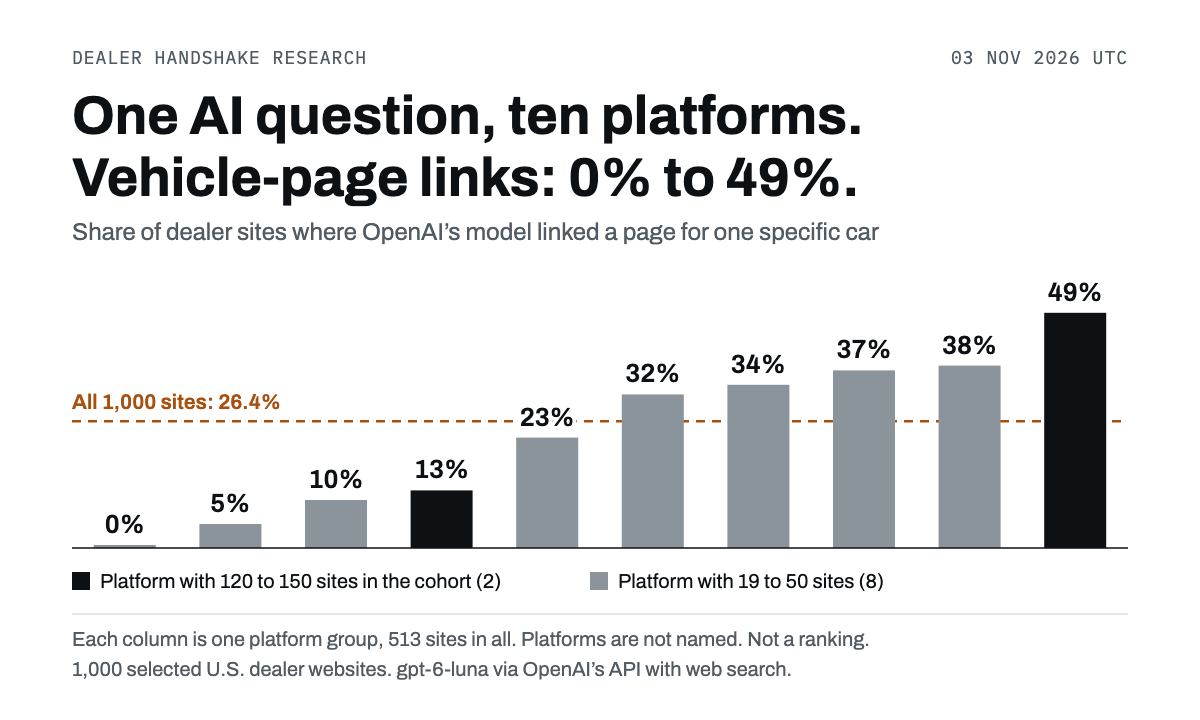
OpenAI’s model linked at least one vehicle page on the dealer’s own site for 264 of 1,000 U.S. dealership websites (26.4%) when we named each site and asked for up to three used cars on November 3, 2026 UTC. Across the ten website platforms with at least 19 sites each, that rate ran from 0% to 49%.
We could establish the platform for 534 sites from evidence in the page code and footer credits. Those ten platform groups hold 513 of them. The two largest groups in the cohort, each with 120 to 150 sites, came in at 49% and 13%. The other eight, each with 19 to 50 sites, ranged from 0% to 38%. Sites with no established platform landed at 26% (121 of 466).
A vehicle page is a narrow result. Almost every answer cited the dealer’s site in some form (958 of 1,000, from our 1,000-site study). For 623 sites the most specific own-site link was an inventory or search page, and for 58 it was the homepage. Only the vehicle page puts one car, its price and a way to ask about it in front of the shopper.
We do not name the platforms, and the chart is not a ranking. The cohort was selected for a mix of website providers, so a group’s size here says nothing about its market share. Platforms also change their templates, so treat this as a snapshot of November 3, 2026.
Sites on one platform shared their technical results
Our crawler reached 866 of the 1,000 sites on the same day and ran the same checks on each. For six checks that bear on what an AI fetcher can read, we took every platform with at least 15 sites where the check returned a result. On most of those platforms, at least 90% of the sites had the same result.
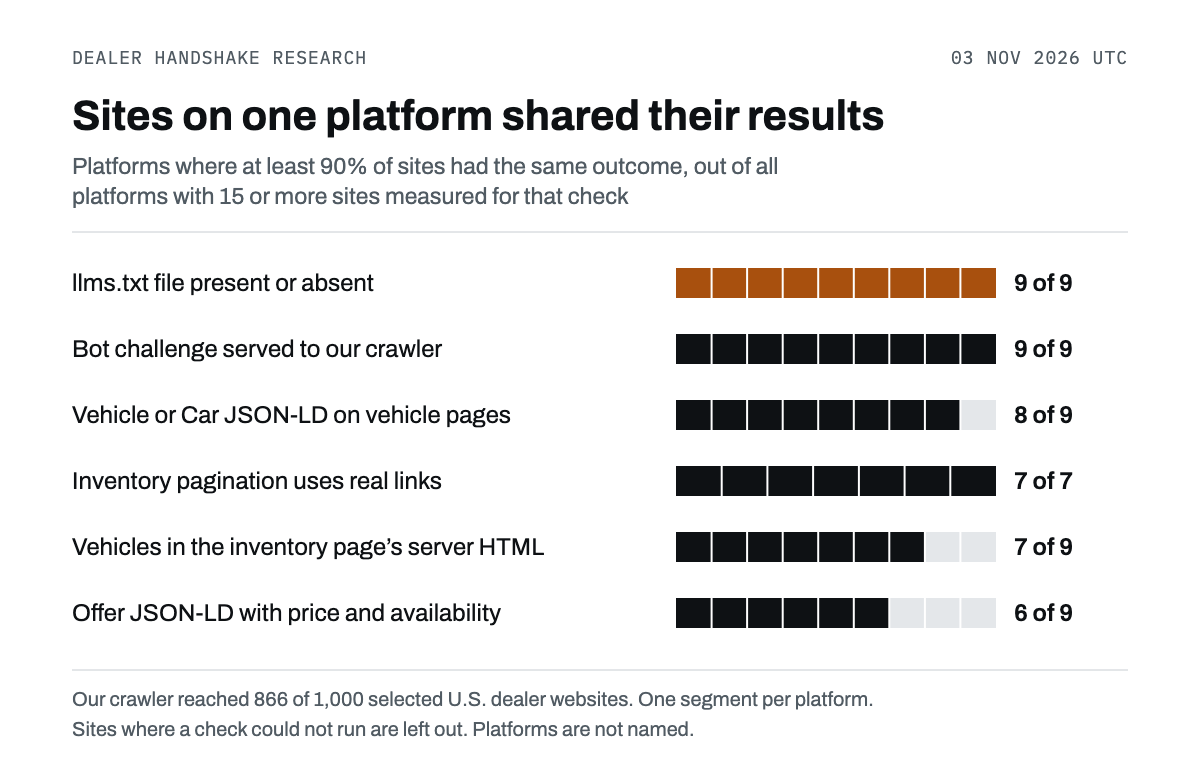
When a setting moves with the platform like this, comparing one platform with another cannot separate that setting from everything else the platform does. The next two sections compare sites inside the same group instead.
llms.txt for car dealers: no advantage in this data
llms.txt is a Markdown file at /llms.txt that gives language models a readable summary of a site. Its author presents it as a proposal (llmstxt.org, read November 24, 2026). It was common in the cohort. Of the 709 sites where our crawler could request /llms.txt and classify the reply, 483 had one (68.1%).
Sites with the file were no more likely to get a vehicle page linked. Among sites with no established platform, 17% of those with llms.txt had one (27 of 163), against 23% of those without it (15 of 65). Only one established platform had enough sites on both sides to compare, and there the two rates were within one point of each other.
The file did not sort the platforms either. The platforms that had llms.txt on at least 90% of their sites included groups above 30% and groups below 15%. So did the platforms that had it on almost none of their sites. Our data cannot show whether the model opened an llms.txt file during its search.
What still differed inside the same group
Most checks could only be compared inside the 466-site group with no established platform, because inside a single platform nearly every site had the same result.
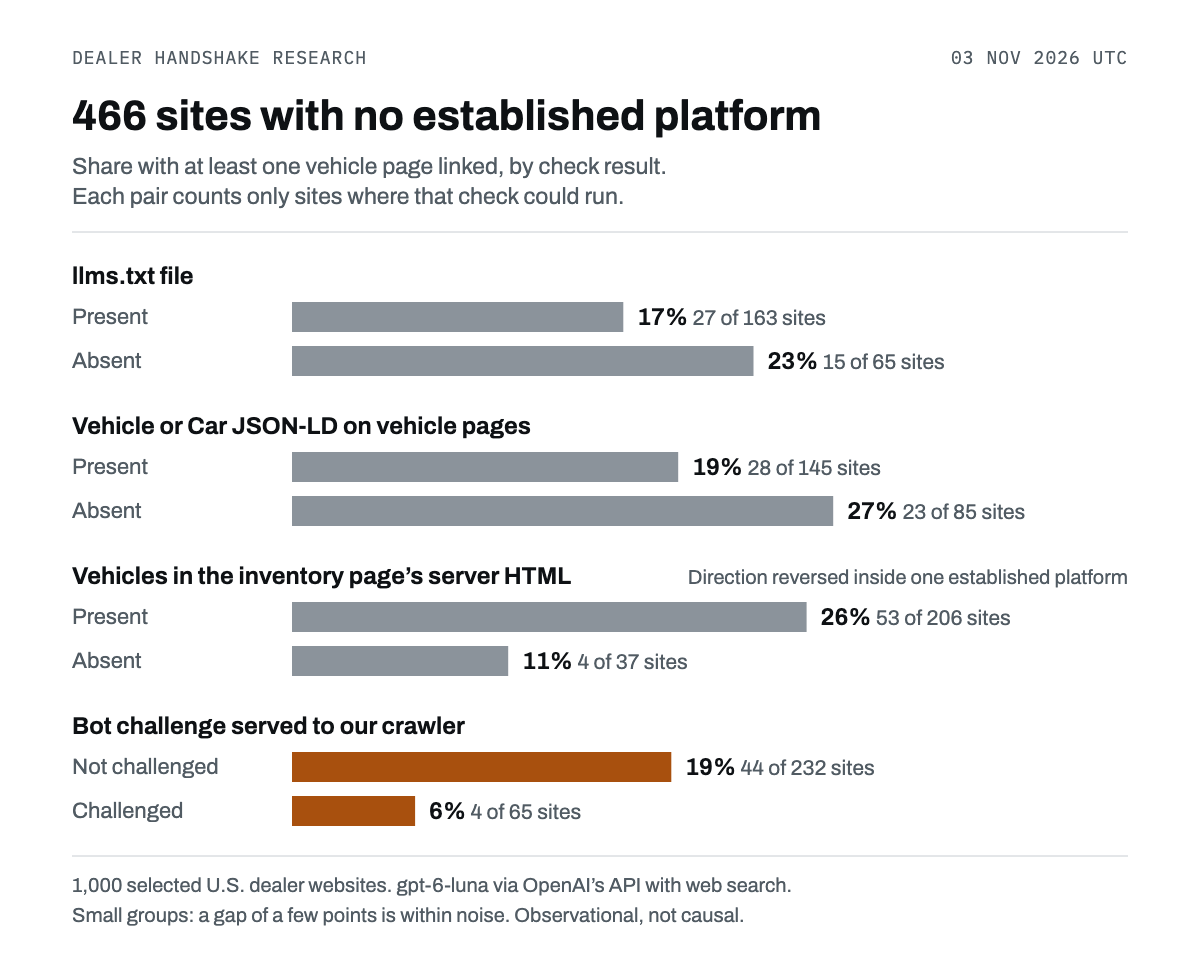
Bot challenges were the one site-level setting that still went with fewer vehicle links. A bot challenge here means a web application firewall answered our named crawler with a challenge page in place of the website. That happened on 70 of the 774 sites that gave the crawler a usable homepage response (9.0%), and 65 of those 70 had no established platform. In that group, 6% of challenged sites had a vehicle page linked (4 of 65), against 19% of sites that were not challenged (44 of 232). With groups this small, even this gap falls short of a strict multiple-comparison test (see methods).
Challenged sites were still cited. 69 of the 70 appeared in the answers, and for 64 of them the most specific link was an inventory or search page. Four got a vehicle page. Our robots.txt and firewall study covers which crawlers dealer sites block or challenge.
The other checks gave no consistent signal. Vehicles in the inventory page’s server HTML went with more links in the no-platform group, 26% (53 of 206) against 11% (4 of 37). Two established platforms had at least five sites on each side. In one, neither side had a vehicle page linked, and in the other the direction reversed. Vehicle or Car structured data showed no advantage (19% of 145 with it, 27% of 85 without). Neither did pagination through real links (25% of 109 against 22% of 135) or Offer markup with price and availability (19% of 140 against 28% of 90).
How we read these results
This section is our interpretation. The data shows associations in one cohort on one day and proves none of what follows.
A platform usually decides how the inventory and vehicle pages are built and which requests its firewall lets through. No single check we ran accounts for the spread between platforms, and the two largest groups alone, at 49% and 13%, were more than 35 points apart. That fits a set of template decisions acting together better than one missing file. For a dealership, it means that whether an AI answer can point at a specific car is mostly set at the platform level.
For bot challenges, the plausible reason is simple. A fetcher that receives a challenge page cannot read the car, so the answer falls back to a page it reached some other way. We measured our own crawler, not OpenAI’s fetchers, so this is unproven. The comparison also has a measurement problem. A challenge page hides the page code and footer credits we used to identify a platform, which probably explains why challenged sites piled up in the no-platform group. That group mixes many platforms, so the comparison inside it does not hold the platform fully constant.
Dealer website AI readiness: five questions for your provider
Put these questions at the start of a dealership AI visibility audit. They are about the platform, so your website provider is the one who can answer them. Ask for each answer to be shown on one of your own vehicle pages.
- Does the used inventory page send its vehicles in the HTML the server returns? You can check this yourself. Open the page in Chrome, right-click, choose View page source and search for the stock number of a car you can see on screen. If it is missing, scripts add the cars after the page loads, and a fetcher that does not run scripts sees no cars.
- Does every vehicle page carry the VIN, price and availability in the visible text and in structured data? In the page source, search for
vehicleIdentificationNumberandavailability, the schema.org property names for the VIN and stock status (schema.org Vehicle and Offer, read November 24, 2026). The markup alone did not go with more links in our data. Ask for it because an answer quotes these facts about the car, as our VIN check shows. - Which bots does your firewall challenge or block? Ask for the list, and ask about OpenAI’s agents by name. OpenAI’s documentation says OAI-SearchBot is used to surface websites in ChatGPT’s search features and ChatGPT-User handles certain actions a user starts in ChatGPT. OpenAI publishes the IP addresses each one uses (OpenAI bots documentation, read November 24, 2026).
- Can a named AI crawler read one of your vehicle pages today? Ask for the server or firewall log entry for a request from one of OpenAI’s published addresses to a vehicle page, with its status code. You want status 200 from the vehicle page itself. A challenge page or a 403 means that request did not get the car.
- Is llms.txt on by default, and what is in it? If it is offered as a paid add-on for AI visibility, weigh the price against this data. Sites with the file did no better in either comparison we could run.
If your group runs rooftops on more than one platform, test one rooftop per platform with the steps below. That is the comparison this data points to, and you can run it on your own stores.
Test your own site
Start with the free Dealer Handshake website scan. Then save one AI answer. Open a new chat and ask the question from our study, with your own address in it:
“Find up to three used passenger vehicles currently advertised by the dealership whose official website is [your website address]. Search the web. Prefer the dealership’s own vehicle detail pages. For each vehicle give year, make, model, advertised price, VIN only if explicitly supported, and a direct source link.”
Record the date, the assistant, the full answer and every link. Open each link and note whether it lands on a page for one car on your site, an inventory search page or the homepage. Ask again on another day before you draw a conclusion, since one answer is one sample. The ChatGPT app is a different setup from the API model we tested, so your result can differ from ours.
Methods, limits and data
Cohort and question. 1,000 selected U.S. dealership websites, including dealer-group sites, chosen for a mix of website providers, not at random and not weighted by market share. Each site got one question: the prompt quoted above plus three sentences asking the model to separate dealer evidence from third-party listings, not to guess, and to stay under 450 words. It went once to gpt-6-luna through OpenAI’s API with web search, low reasoning effort, low search context, up to two tool calls and a 2,000-token output limit. This is not the consumer ChatGPT app. Four requests that failed with transport or server errors were retried once with the same settings. No completed answer was repeated.
Outcome. A site counted when at least one cited link to its own site pointed to a single vehicle, judged from the URL path, such as a VIN or a vehicle-detail path. We did not open those pages to confirm that the car was still for sale or that the price was right.
Platform and checks. Platforms were identified from page code and footer credits. Hosting, analytics and chat tools did not count. That worked for 534 sites across 24 platforms, and the 21 sites on the 14 platforms with fewer than 19 sites are left out of the per-platform rates. Our crawler named itself in its user agent, signed its requests and reached 866 sites. Comparisons count only checks that returned pass or fail, so denominators differ by check. Within-platform comparisons needed at least five sites on each side.
Statistics. Inside the no-platform group, Fisher’s exact test put the bot-challenge gap at p = 0.013 and the server-HTML gap at p = 0.058. The llms.txt and structured-data gaps were within chance (p = 0.26 and p = 0.19). We ran six such comparisons, and none would pass a strict Bonferroni correction (threshold 0.008). The gap between the two largest platforms was far beyond chance (p below 0.0001). Each site got its own answer, so the tests treat sites as independent.
Not measured. Whether changing a platform, a firewall rule or an llms.txt file changes the result. Other assistants and repeat runs. Whether OpenAI’s fetchers met the challenges our crawler met. Inquiries, leads and sales.
Data. The aggregate study results and exact prompts (JSON) and the results table (CSV) are public. Per-platform counts are not published, so that the platforms stay anonymous.
Prepared with AI assistance and checked against the retained study records. Published November 24, 2026 from data collected November 3, 2026 UTC. External pages were read on November 24, 2026. Dealer Handshake connects dealer-authorized inventory to compatible AI assistants and routes shopper-approved inquiries into the dealership’s existing CRM workflow, so we have a commercial interest in this topic. This article reports no customer outcome.